
 +86 15853145085

 全国服务热线
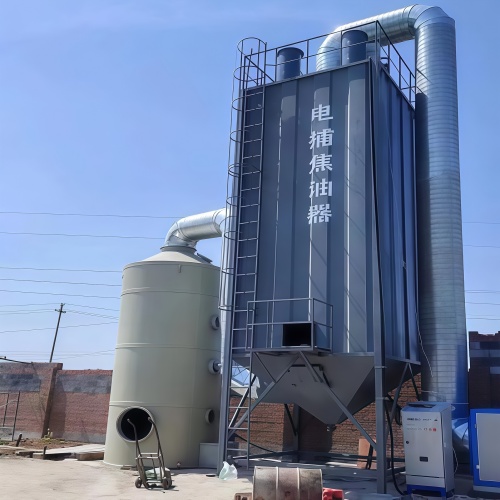
The electric tar precipitator is an efficient equipment for tar waste gas treatment. Its core principle is to ionize and capture tar droplets in waste gas by using a high-voltage electrostatic field to realize gas-liquid separation. The purified gas can be discharged up to standard or recycled.
Working Principle
Ionization Stage
High-voltage direct current is applied between the cathode (corona electrode) and the anode (precipitation electrode) to form a strong electrostatic field. The electric field strength near the cathode is extremely high, which generates corona discharge and ionizes surrounding gas molecules into positive and negative ions.
Charging Stage
Particulates such as tar droplets and dust in waste gas adsorb ions and carry electric charges when passing through the electric field.
Capturing Stage
Charged tar droplets move toward electrodes with opposite polarities under the action of electric field force. Negatively charged droplets move to the anode plate, while positively charged droplets move to the cathode wire.
Ash and Liquid Discharging Stage
The tar attached to the electrodes gradually accumulates to form a liquid film, which flows down along the electrode surface by gravity and collects in the tar tank at the bottom of the equipment for regular discharge. The purified gas is discharged from the top or side of the equipment.
Main Types
According to structural forms, electric tar precipitators are divided into three common types:
Concentric Circle Type
It consists of multiple concentric anode cylinders and a central cathode wire. It features a compact structure but has high difficulty in manufacturing and maintenance.
Tube Type
The anode is composed of a bundle of parallel metal tubes with cathode wires suspended at the center of each tube, which is suitable for working conditions with small gas flow.
Honeycomb Type
The anode is composed of hexagonal honeycomb plates with cathode wires placed in the center. It has high space utilization rate and good collection efficiency, and is the most widely used type at present.
Advantages and Application Scenarios
Core Advantages
High Collection Efficiency: The removal rate of fine tar droplets can reach more than 95%, even up to 99%.
Low Pressure Loss: The internal gas channel is smooth with a pressure loss of 50~200Pa, resulting in low energy consumption.
Large Processing Capacity: It can adapt to various waste gas treatment scales ranging from thousands to hundreds of thousands of cubic meters per hour.
Recyclable Tar: The captured tar can be recycled and reused to realize resource recovery.
Application Scenarios
It is mainly used in industries producing tar droplets such as coal chemical industry, coking plants, gas stations, asphalt mixing stations and carbon plants to treat industrial waste gas containing tar.
Operation Precautions
Explosion-proof Requirements
Most tar waste gas is flammable and explosive. The electric tar precipitator shall adopt an explosion-proof structure, equipped with safety devices such as nitrogen protection and oxygen content monitoring to prevent explosion caused by electrostatic sparks.
Regular Maintenance
Tar dirt on the electrodes shall be cleaned regularly to avoid the reduction of electric field strength and collection efficiency. Insulating components shall be inspected to prevent electric leakage.
Working Condition Control
Inlet temperature, humidity and tar concentration shall be controlled within the design range. Excessively high temperature reduces tar viscosity and makes adhesion difficult; excessive humidity may cause electrode corrosion.
Advantages of Electric Tar Precipitator
Extremely High Collection Efficiency
The removal rate of fine tar droplets in waste gas can exceed 95%, and even reach 99% under partial working conditions. Compared with traditional mechanical and washing tar removal methods, it can capture tiny tar particles more efficiently with stable purification effect.
Low Operation Resistance and Energy Consumption
The internal gas passage is smooth with a pressure loss of only 50~200Pa, reducing fan energy consumption. Its power consumption is relatively controllable, ensuring good economical efficiency for long-term operation.
Recyclable Tar Resources
The captured tar accumulates in the bottom tar tank and can be directly recycled as fuel or chemical raw materials. It reduces hazardous waste disposal costs and creates economic benefits.
Large Processing Capacity and Strong Adaptability
Customized equipment with gas processing capacity from thousands to hundreds of thousands of cubic meters per hour can meet the waste gas treatment demands of enterprises of different scales such as coking and gas processing plants.
No Secondary Pollution
The purification process adopts physical electrostatic adsorption and separation without adding chemical agents. No new wastewater or waste residue is generated, lowering subsequent environmental treatment pressure.
Working Principle of Electric Tar Precipitator
The core working principle of the electric tar precipitator is to charge tar droplets through a high-voltage electrostatic field and adsorb droplets on electrodes by electric field force to complete gas-liquid separation. The whole process includes four key stages:
Corona Ionization Stage
Tens of thousands of volts of high-voltage direct current is applied between the cathode wire and the anode plate or cylinder to form a strong electrostatic field. Extremely high electric field intensity near the cathode wire triggers corona discharge, ionizing gas molecules into a large number of positive and negative ions.
Particle Charging Stage
When waste gas containing tar droplets passes through the electrostatic field, tar droplets collide with ions and carry electric charges to form charged tar particles.
Directional Capture Stage
Charged tar particles move directionally toward opposite electrodes under electric field force. Negatively charged particles move to the anode plate or cylinder, while positively charged particles move to the cathode wire and finally adhere to the electrode surface.
Liquid Discharging and Purification Stage
Tar particles attached to electrodes gradually gather to form liquid films, which flow downward by gravity and finally collect in the bottom tar tank for regular discharge. The purified gas is discharged from the outlet to complete the tar removal process.