
 +86 15853145085
A large amount of waste gas containing organic solvents such as benzene, toluene, xylene (BTX), ethyl acetate and methyl ethyl ketone, as well as metallic paint mist particles are generated during the coating operation of engine shell, chassis parts and body panels in auto parts spray booth. These waste gas will reduce the visibility inside the spray booth, affect coating accuracy and operator health. It will also pollute the surrounding soil, water body and atmospheric environment, causing strict supervision by environmental protection departments and complaints from surrounding residents. According to the characteristics of auto parts spray booth waste gas, such as complex composition, metal impurities contained in paint mist and large concentration fluctuation, the combined process of pretreatment, dry filtration, activated carbon adsorption and catalytic combustion is adopted to provide compliant and economical treatment solutions for enterprises.
1. Source and Hazard of Auto Parts Spray Booth Waste Gas
The waste gas of auto parts spray booth is mainly divided into two parts. Firstly, organic solvents in coatings (especially metallic paint and anti-corrosion paint) volatilize during spraying process. Secondly, metal-containing paint mist is formed during gun spraying. In addition, the forced ventilation system of the spray booth continuously discharges unsettled paint mist and volatile organic solvent waste gas to form continuous waste gas emission.
Organic solvents in the waste gas are highly toxic and irritating. Long-term inhalation will cause dizziness, fatigue and respiratory damage to operators, and seriously damage liver, kidney and nervous system in severe cases. Metal-containing paint mist particles not only adhere to the surface of production equipment to cause equipment failure and affect product coating quality, but also enter human body through respiratory tract to induce heavy metal accumulation poisoning. At the same time, volatile organic compounds (VOCs) in waste gas are important precursors of ozone pollution and PM2.5, which will aggravate regional air pollution and violate relevant regulations such as Standard for Non-Organized Emission Control of Volatile Organic Compounds.
2. Auto Parts Spray Booth Waste Gas Treatment Process
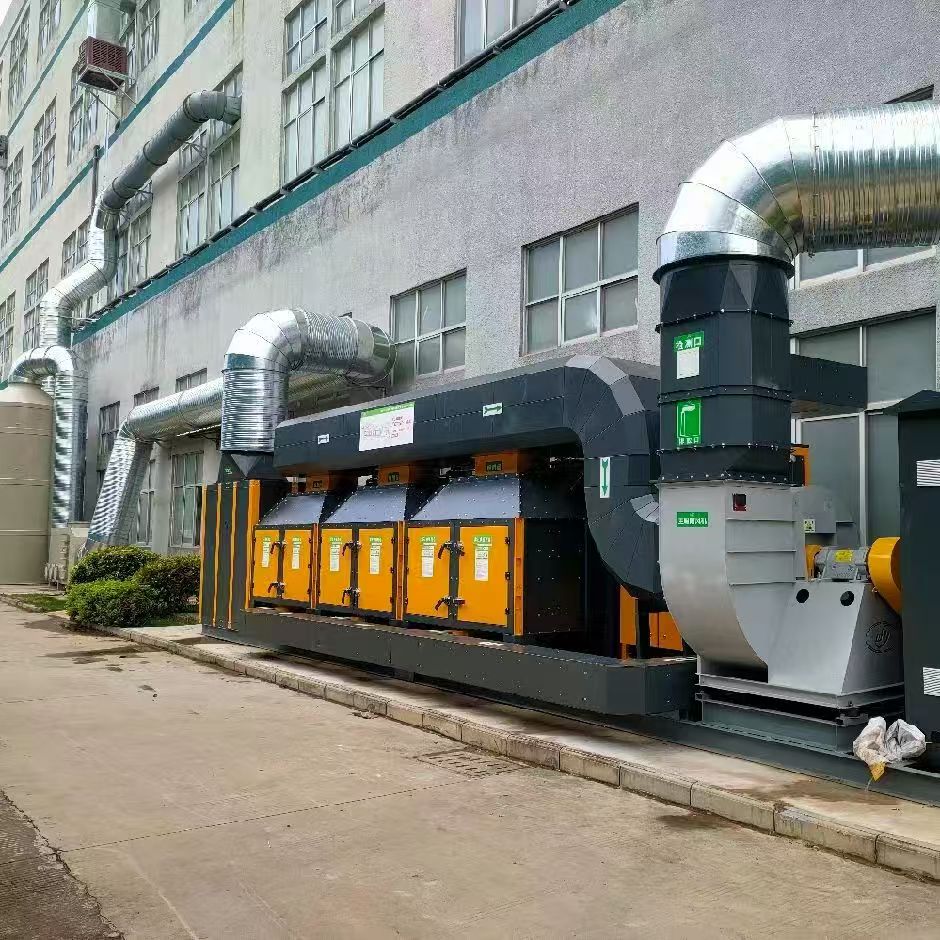
Combined with the characteristics of auto parts spray booth waste gas containing metallic paint mist, complex composition and large concentration fluctuation, the treatment process is formulated as follows. After collected by the gas collection system, the waste gas firstly passes through the pretreatment device to remove large particle impurities and partial oily substances. Then it enters the dry filter for deep removal of paint mist particles, and flows into the activated carbon adsorption device to adsorb organic waste gas. When the activated carbon is close to saturation, the catalytic combustion device is started for activated carbon regeneration. The adsorbed organic matters are desorbed and oxidized to realize compliant discharge of waste gas.
3. Process Description of Pretreatment + Dry Filtration + Activated Carbon Adsorption + Catalytic Combustion
Special gas collecting hoods are installed at each spraying station and leveling area of the auto parts spray booth. The waste gas is uniformly transported to the treatment system through high-temperature resistant and anti-corrosion air ducts. The waste gas firstly enters the pretreatment device, which adopts gravity sedimentation and water spray pretreatment to remove partial soluble impurities and large paint mist particles for preliminary purification. Then the waste gas enters the dry filtration unit. The unit is equipped with primary filter cotton, medium efficiency filter bag, high-efficiency glass fiber filter paper and metal impurity filter layer in sequence. It can efficiently intercept residual paint mist particles, especially metal particles, with filtration efficiency higher than 99%, avoiding pipeline blockage and catalyst poisoning caused by paint mist entering subsequent equipment.
The purified waste gas after dry filtration enters the activated carbon adsorption box filled with modified activated carbon. The adsorption performance is optimized for common solvents used in auto parts coating. Its rich micropore structure can efficiently adsorb organic solvents in waste gas. When the activated carbon reaches adsorption saturation, the control system automatically starts the catalytic combustion device. The air is heated to the set temperature and delivered into the activated carbon box to desorb organic matters and form high-concentration organic waste gas. The high-concentration waste gas flows into the catalytic combustion furnace. Under the action of precious metal catalysts (platinum and palladium), oxidation reaction occurs at low temperature of 250-350℃, and organic matters are completely decomposed into non-toxic carbon dioxide and water. After detection, the qualified gas is discharged into the atmosphere through a high exhaust funnel. The desorbed activated carbon restores adsorption performance for recycling, and only regular inspection and replacement of aging activated carbon are required.
4. Advantages of Auto Parts Spray Booth Waste Gas Treatment Equipment
1. High purification efficiency: Pretreatment and multi-stage dry filtration can completely remove metallic paint mist. The combined technology of activated carbon adsorption and catalytic combustion achieves organic waste gas removal rate above 95%. The overall purification efficiency meets national and local VOCs emission standards.
2. Energy saving and environmental protection: Catalytic combustion adopts low-temperature oxidation technology, and its energy consumption is only 1/3 to 1/2 of direct combustion. Activated carbon can be recycled and regenerated to reduce solid waste generation. The heat generated during regeneration can be partially recycled to reduce operating cost.
3. Stable operation: The equipment is equipped with a full-automatic control system to real-timely monitor waste gas concentration, operating temperature, pressure and other parameters, and automatically switch adsorption and regeneration modes with low failure rate. Core components are made of corrosion-resistant and high-temperature resistant materials, adapting to complex working conditions of auto parts coating.
4. Strong pertinence: The special metal impurity filter layer can effectively intercept metal particles in paint mist to prevent catalyst poisoning, which is suitable for waste gas generated by metallic paint, anti-corrosion paint and other coatings.
5. Safe and reliable: Multiple safety protection measures such as explosion-proof device, temperature early warning system and nitrogen protection system are configured to effectively avoid fire and explosion accidents caused by accumulation of organic waste gas.
6. Compliance and efficiency improvement: It completely solves waste gas pollution problems, helps enterprises pass environmental acceptance, improves operating environment, promotes product coating quality and enhances enterprise market competitiveness.
If you need customized waste gas treatment solutions for auto parts spray booth, or want to know detailed parameters and operating costs of pretreatment + dry filtration + activated carbon adsorption + catalytic combustion equipment, please contact Zhonghuan Lvzhou Environmental Protection. Tel: 158-5314-5085. We will provide personalized solutions according to your production scale and coating types.