Ⅰ. Scheme Background and Waste Gas Characteristics
Complex organic waste gas is generated during rubber production processes such as mixing, vulcanization and shaping. The main components include non-methane total hydrocarbons (NMHC), benzene series (benzene, toluene, xylene), sulfides (hydrogen sulfide, carbon disulfide) and a small amount of volatile organic compounds (VOCs). This type of waste gas is characterized by complex composition, severe concentration fluctuation, obvious peculiar smell and flammability. Direct discharge will not only pollute the atmospheric environment and harm the health of operators, but also violate the Integrated Emission Standard of Air Pollutants (GB 16297) and local environmental protection regulations. Therefore, efficient and stable treatment technology is required for rubber waste gas purification.
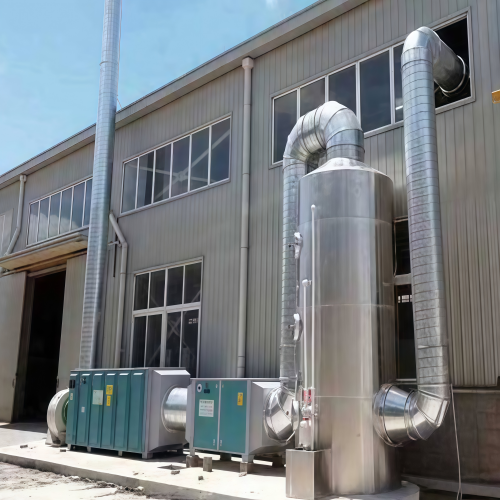
Ⅱ. Treatment Objectives
1. Purification Efficiency
The removal rate of non-methane total hydrocarbons ≥90%, benzene series ≥95%, and sulfides ≥85%. All emission concentrations after treatment shall comply with the limit requirements of GB 16297 and local environmental protection departments.
2. Operational Stability
The continuous operation failure rate of equipment ≤3%. The system adapts to waste gas concentration fluctuation ranging from 100-1000mg/m³ to ensure long-term stable compliant discharge.
3. Safety and Environmental Protection
No secondary pollution is generated during the treatment process. The regeneration and disposal of activated carbon shall comply with hazardous waste management regulations. The equipment is equipped with explosion-proof, fireproof and leakage-proof safety measures.
4. Economic Efficiency
Reasonable investment cost, low energy consumption and convenient operation & maintenance. The comprehensive treatment cost is controlled within a reasonable industry range.
Ⅲ. Core Principle of Activated Carbon Adsorption Method
Activated carbon relies on its developed pore structure and large specific surface area (generally ≥1000m²/g) to purify rubber waste gas through combined physical and chemical adsorption of organic pollutants and sulfides. The core principles are as follows:
1. Physical Adsorption
Waste gas molecules are adsorbed on the pore surface of activated carbon under Van der Waals force to form adsorption equilibrium.
2. Chemical Adsorption
Functional groups on the activated carbon surface (such as hydroxyl and carboxyl groups) chemically react with sulfides to generate stable compounds and strengthen the adsorption effect.
This technology has the advantages of high adsorption efficiency, simple operation and wide applicability, especially suitable for medium and low-concentration rubber waste gas.
Ⅳ. Process Flow and Unit Description
1. Process Flow Chart
Rubber Waste Gas Source → Gas Collection Hood → Air Duct → Pretreatment Device (Spray Washing Tower) → Fan → Activated Carbon Adsorption Tower (Double-tower Parallel) → Compliant Exhaust Outlet
2. Functional Description of Each Unit
(1) Gas Collection Hood and Air Duct
Closed or semi-closed gas collection hoods are arranged according to the layout of rubber production equipment to ensure the gas collection efficiency ≥90%. The air duct is made of anti-corrosion and flame-retardant materials (such as FRP), with wind speed controlled at 10-15m/s to reduce gas retention and pipeline dust accumulation.
(2) Pretreatment Device (Spray Washing Tower)
Rubber waste gas contains a small amount of dust, oil mist and soluble sulfides, which will block carbon pores and reduce adsorption efficiency. The alkaline spray liquid (NaOH solution, concentration: 0.5-1%) is adopted for countercurrent gas-liquid contact. The tower removes more than 80% of dust and oil mist and over 50% of sulfides, while cooling the waste gas below 40℃ (the optimal adsorption temperature of activated carbon: 20-40℃).
(3) Fan
Anti-corrosion and explosion-proof centrifugal fan is selected. The wind pressure is matched according to the treatment air volume (5000-20000m³/h based on production scale) to ensure stable gas delivery. Shock-absorbing base and silencer are installed to reduce operating noise.
(4) Activated Carbon Adsorption Tower (Double-tower Parallel)
The double-tower parallel structure realizes continuous operation with one tower for adsorption and the other for carbon regeneration or replacement. The tower body is made of carbon steel with anti-corrosion treatment. Granular activated carbon (particle size: 2-4mm, iodine value ≥1000mg/g, methylene blue adsorption value ≥150mg/g) is filled with a filling height of 1.5-2m. The airflow velocity is controlled at 0.3-0.5m/s to ensure sufficient gas-carbon contact with adsorption time ≥3s. Grids and filter screens are installed to prevent carbon loss, and a demisting device is equipped at the top to avoid water mist entrainment.
(5) Compliant Exhaust Outlet
Purified waste gas is discharged through an exhaust stack higher than 15m. An online monitoring interface is reserved on the stack to real-timely monitor the emission concentration of NMHC and benzene series for compliance guarantee.
Ⅴ. Core Equipment Selection Parameters
Equipment Name | Model Specification | Key Parameters | Quantity |
|---|
Spray Washing Tower | Φ1200×4500mm | Air volume: 5000-10000m³/h; Resistance: 800-1200Pa | 1 Set |
Explosion-proof Centrifugal Fan | 4-72-6C | Air volume: 8000m³/h; Wind pressure: 1500Pa; Power: 7.5kW | 1 Set |
Activated Carbon Adsorption Tower | Φ1500×5000mm | Single tower carbon filling capacity: 1.5m³; Air velocity: 0.4m/s | 2 Sets (Parallel) |
Activated Carbon | Granular Wood-based Carbon | Iodine value ≥1100mg/g; Ash content ≤8%; Moisture ≤10% | 3m³ (Initial filling) |
Gas Collection Hood | Customized | Collection efficiency ≥90%; Matched with production equipment size | Customized Quantity |
Ⅵ. Operation and Maintenance Requirements
1. Operation Specifications
Startup Sequence: Start the spray washing tower firstly → activate the fan → turn on the adsorption tower after system wind pressure stabilizes. The shutdown sequence is reversed.
The spray tower shall be supplemented with alkaline liquid regularly to maintain pH value between 8-10. The spray liquid is replaced and sediment is cleaned every week.
Monitor inlet and outlet gas concentration in real time. When the outlet NMHC concentration reaches 80% of the emission limit, switch to the standby tower. Saturated carbon is regenerated by hot air desorption (desorption temperature: 120-150℃), and the desorbed waste gas is sent back to the pretreatment unit for secondary treatment. Waste carbon that cannot be regenerated shall be disposed by qualified institutions as hazardous waste.
Monitor fan current, wind pressure and noise to ensure stable operation. Regularly inspect belt tension and bearing temperature to avoid overload operation.
2. Maintenance Plan
Daily Inspection: Check the air tightness of hoods and ducts; monitor the liquid level and pH value of the spray tower; record gas concentration and equipment operating parameters.
Weekly Inspection: Clean tower packing and sediment; inspect air leakage and carbon loss of adsorption towers; conduct fan lubrication maintenance.
Monthly Inspection: Detect carbon adsorption efficiency and replace failed carbon; inspect and repair anti-corrosion coating of pipelines and equipment.
Annual Maintenance: Conduct comprehensive equipment overhaul and replace aging parts; entrust a third-party institution to complete emission detection to meet environmental standards.
Ⅶ. Safety and Environmental Protection Guarantee
1. Safety Protection Measures
Rubber waste gas is flammable and explosive. All fans, motors and electrical cabinets adopt explosion-proof design. Explosion relief sheets (relief pressure: 0.05MPa) and nitrogen purging interfaces are installed on adsorption towers to prevent local high temperature and spontaneous combustion. Combustible gas detectors are equipped in the workshop, interlocked with ventilation and emergency shutdown devices. Operators shall wear protective supplies and receive regular safety training.
2. Environmental Protection Measures
Wastewater from the spray tower is neutralized (pH adjusted to 6-9) for reuse or discharged to the sewage system to avoid secondary pollution. Waste activated carbon is classified and sealed for storage, and transferred

 +86 15853145085