
 +86 15853145085

 全国服务热线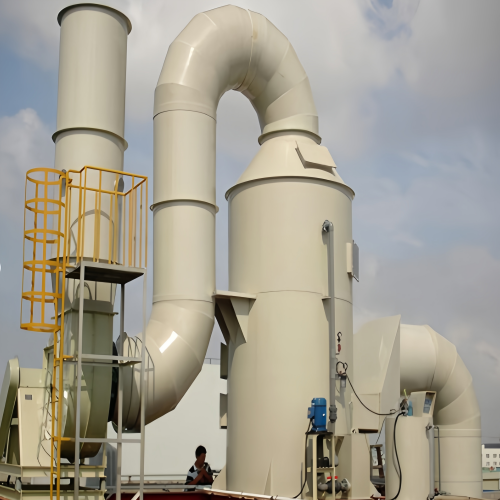
The ammonia removal spray tower is a gas-liquid contact equipment used to remove ammonia from waste gas. It is widely applied in chemical, chemical fertilizer, breeding, garbage disposal and other industries.
Working Principle
Waste gas enters the ammonia removal spray tower from the bottom and makes countercurrent contact with the washing liquid sprayed downward from the top. The washing liquid is usually acidic solution such as dilute sulfuric acid or phosphoric acid. As an alkaline gas, ammonia reacts with acidic washing liquid to generate ammonium salt, so that ammonia is fixed in the liquid phase to realize ammonia removal. Taking sulfuric acid as an example, the chemical reaction equation is: 2NH₃+H₂SO₄→(NH₄)₂SO₄. During the washing process, part of the washing liquid is carried out of the tower top in the form of droplets. Therefore, the spray tower is generally equipped with a demister to separate and recover liquid droplets.
Key Technologies
Selection and Concentration Control of Washing Liquid
Common washing liquids include dilute sulfuric acid, phosphoric acid and nitric acid. Sulfuric acid is widely used due to its low cost and high reaction efficiency. The concentration of washing liquid shall be adjusted according to the ammonia content in waste gas, and the pH value is generally controlled between 2 and 4.
Selection and Design of Packing
Packing is the core component of the ammonia removal spray tower. Common packing types include Raschig ring, Pall ring and structured packing. The larger the specific surface area of packing, the larger the gas-liquid contact area and the higher the ammonia removal efficiency. However, excessive specific surface area may increase pressure drop and energy consumption, so it is necessary to balance efficiency and energy consumption.
Control of Gas-Liquid Ratio
The gas-liquid ratio refers to the ratio of waste gas flow rate to washing liquid flow rate, which is generally controlled from 10:1 to 20:1. Excessively high gas-liquid ratio leads to insufficient ammonia absorption and reduced purification efficiency; excessively low gas-liquid ratio causes waste of washing liquid and increased equipment load.
Temperature and Pressure Control
High temperature reduces the solubility of ammonia in liquid phase, so the waste gas temperature shall be controlled at 20-40℃. Appropriate pressure improves gas-liquid contact efficiency, while excessive pressure increases equipment cost and energy consumption.
Advantages and Limitations
Advantages
The ammonia removal spray tower has high purification efficiency with ammonia removal rate above 90%, which is suitable for waste gas with high ammonia concentration. It is highly flexible; parameters such as washing liquid type, concentration and gas-liquid ratio can be adjusted to adapt to different working conditions. Moreover, the construction and operation cost is relatively low, which is suitable for large-scale application.
Limitations
The acidic washing liquid is corrosive to equipment, so corrosion-resistant materials or anti-corrosion treatment are required. The waste liquid containing ammonium salt after washing needs further treatment or recycling to avoid secondary pollution. The operation consumes electric energy and water resources, especially under high gas-liquid ratio and high air volume conditions with relatively high energy consumption.
Advantages of Ammonia Removal Spray Tower
High Ammonia Removal Efficiency
Fully countercurrent contact between gas and liquid phase combined with chemical absorption of acidic washing liquid ensures the ammonia removal rate higher than 90%. It is especially suitable for treating waste gas with high ammonia concentration.
Strong Working Condition Adaptability
Parameters including washing liquid type (dilute sulfuric acid, phosphoric acid), concentration and gas-liquid ratio can be adjusted to adapt to different ammonia concentration and air volume, featuring high operation flexibility.
Low Construction and Operation Cost
The equipment has a simple structure with low manufacturing and installation cost. The raw materials of acidic washing liquid are easily available and inexpensive, resulting in low overall operation and maintenance difficulty.
Simple Operation and Maintenance
The operation process is intuitive without complicated control links. Daily maintenance mainly includes packing cleaning, washing liquid replenishment and pH adjustment, requiring low technical requirements for operators.
Realizable Resource Recovery
Ammonium salts (such as ammonium sulfate) generated after ammonia absorption can be further separated and purified as chemical fertilizer raw materials for resource utilization, improving economic benefits and reducing waste discharge.
Working Principle of Ammonia Removal Spray Tower
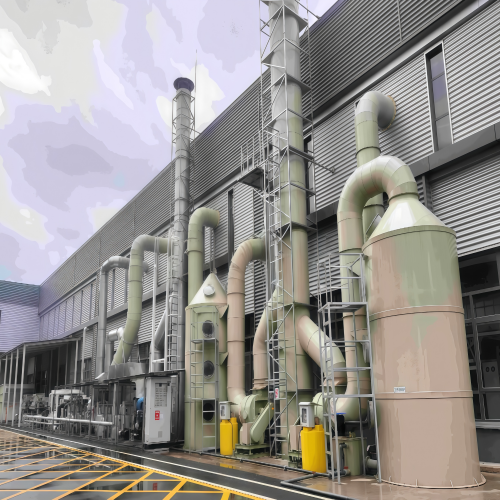
The core working principle of the ammonia removal spray tower is gas-liquid countercurrent contact and acid-base neutralization reaction to efficiently remove ammonia in waste gas. The specific process is as follows:
Reverse Contact Between Waste Gas and Washing Liquid
Ammonia-containing waste gas enters the tower from the bottom and flows upward. Meanwhile, acidic washing liquid (commonly dilute sulfuric acid and phosphoric acid) is atomized and sprayed downward evenly by the top spray system. The gas and liquid fully contact in the packing layer to expand the reaction area.
Acid-Base Neutralization and Chemical Absorption
As an alkaline gas, ammonia reacts with acidic washing liquid to generate water-soluble ammonium salt, transferring ammonia from gas phase to liquid phase. The chemical reaction formula with dilute sulfuric acid is shown as follows: 2NH₃+H₂SO₄=(NH₄)₂SO₄. Dilute phosphoric acid generates ammonium phosphate after reaction.
Gas-Liquid Separation and Standard Discharge
The purified gas passes through the top demister to remove entrained liquid droplets and is discharged from the tower top. The ammonium-containing washing liquid falls into the circulating water tank at the bottom, which can be recycled after treatment or further purified for ammonium salt resource recovery.
Applicable Industries of Ammonia Removal Spray Tower
Based on gas-liquid countercurrent contact and acid-base neutralization reaction, the ammonia removal spray tower is applicable to various industries producing ammonia-containing waste gas for targeted ammonia treatment. The applicable industries are listed as follows:
Chemical and Chemical Fertilizer Industry
High-concentration ammonia-containing waste gas is generated during chemical fertilizer production (synthetic ammonia, urea and ammonium salt manufacturing) and chemical raw material synthesis (pharmaceutical intermediates and dye production). The spray tower can efficiently treat such waste gas to reduce ammonia pollution.
Breeding Industry
A large amount of ammonia is released from manure fermentation and feed decomposition in large-scale livestock and poultry farms. The ammonia removal spray tower purifies ventilation waste gas to improve air quality inside and around the farm.
Garbage and Solid Waste Disposal Industry
Ammonia-containing waste gas is produced during garbage degradation and incineration in landfills, waste incineration plants and kitchen waste treatment stations. Ammonia is also emitted during sludge drying and composting. The spray tower is suitable for treating low and medium concentration ammonia waste gas.
Food Processing Industry
Processes such as monosodium glutamate production, dairy processing and meat pickling generate ammonia-containing wastewater and waste gas. The spray tower is matched with tail gas treatment and waste gas collection systems for purification.
Metallurgy and Electroplating Industry
Ammonia may be released during pickling and passivation before smelting and electroplating. Partial metal quenching and nitriding processes also produce ammonia-containing waste gas. The spray tower is used as terminal waste gas treatment equipment.