
 +86 15853145085
With the acceleration of industrialization and increasingly stringent environmental protection standards, the demand for efficient and economical waste gas treatment technologies has become urgent. As a classic gas purification device, spray towers are widely used in chemical, metallurgical, electronic and other industries due to their simple structure, excellent treatment effect and low operating cost. Statistics show that approximately 65% of acid and alkaline waste gas treatment projects in China adopt spray tower technology.
I. Working Principle and Structural Characteristics of Spray Tower
The core working principle of spray towers is based on the mass transfer process between gas and liquid phases. Waste gas enters from the lower part of the tower and makes countercurrent contact with the downward spraying absorbent. During this process, pollutant molecules diffuse from the gas phase to the liquid phase to complete purification. Spray towers adopt physical absorption or chemical absorption according to different treatment objects. The chemical absorption method can significantly improve the removal efficiency of specific pollutants by adding chemical agents.
A typical spray tower consists of tower body, spraying system, packing layer, mist eliminator and other key components. The tower body is generally made of corrosion-resistant materials such as polypropylene (PP), fiberglass reinforced plastic (FRP) and stainless steel to ensure long-term stability under harsh working conditions. The spraying system includes spraying pipes, nozzles and circulating pumps, whose design directly affects droplet distribution and mass transfer efficiency. As the core mass transfer area, the packing layer provides a large gas-liquid contact area. Common packing includes structured packing such as Pall rings and Raschig rings, as well as random packing.
The structural design of spray towers is highly flexible. Parameters such as tower height, spraying layers and packing types can be adjusted for customized design to meet different treatment requirements. For example, multi-stage spraying is adopted for high-concentration waste gas, and large-channel packing is selected for scaling-prone systems. The modular design enables spray towers to adapt to various complex industrial waste gas treatment scenarios with outstanding technical adaptability.
II. Performance Advantages of Spray Tower
Spray towers have excellent waste gas treatment efficiency. The packing layer provides a large specific surface area, usually ranging from 100 to 300m²/m³, realizing sufficient gas-liquid contact with a pollutant removal rate of over 90%. For soluble gases such as HCl and NH₃, the removal efficiency of a single-stage spray tower can even exceed 98%. Multi-stage series connection and parameter optimization enable spray towers to meet increasingly strict emission standards.
Low operating cost is a prominent advantage of spray towers. Compared with advanced oxidation technologies, the energy consumption of spray towers mainly comes from circulating pumps and fans. The system pressure loss is only 300 to 800 Pa with low energy consumption. In addition, low-cost absorbents such as clean water and alkaline solution are adopted with low reagent consumption. In terms of maintenance, spray towers have no complex mechanical parts. Daily maintenance only includes regular nozzle cleaning and packing inspection, with the annual maintenance cost accounting for 2% to 3% of the equipment investment.
Spray towers feature excellent working condition adaptability. They have a wide temperature adaptation range, and specially designed spray towers can treat waste gas up to 200℃. The processing air volume ranges from hundreds to hundreds of thousands of cubic meters per hour. The system can maintain stable operation by adjusting spraying volume and circulating liquid pH value for waste gas with fluctuating concentration. Moreover, spray towers can remove particulate matter simultaneously to realize combined dust removal and gas purification.
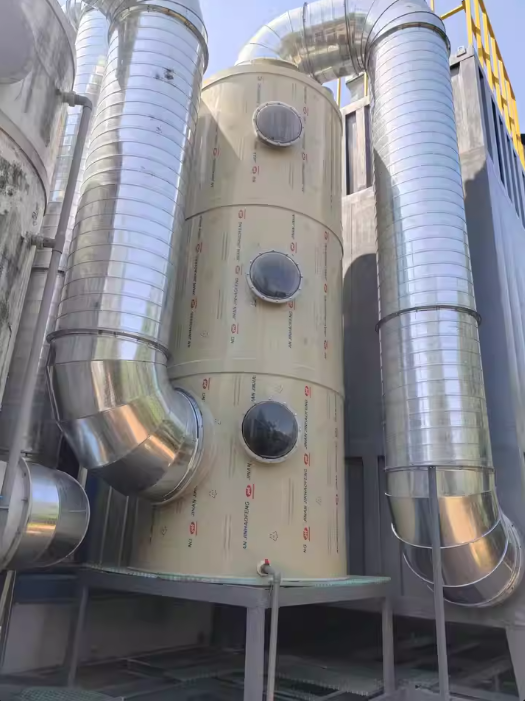
III. Environmental Advantages and Application Fields
Spray towers have unique advantages in secondary pollution control. Adopting a closed circulation system, most of the absorbent can be reused after treatment with less wastewater discharge. For waste gas containing heavy metals and other toxic substances, precipitants can be added into circulating liquid to immobilize pollutants and avoid secondary pollution. Advanced spray tower systems are equipped with automatic dosing and pH control systems to ensure environmentally friendly operation.
Spray towers are widely applied in various industrial fields. In the chemical industry, they efficiently remove toxic gases such as hydrogen chloride, ammonia and hydrogen sulfide. They are used to purify acid mist in pickling processes in the metallurgical industry and treat acidic waste gas generated in etching processes in the electronic industry. They also have successful application cases in garbage disposal, food processing, pharmaceutical and other industries. Notably, spray towers play an irreplaceable role in emergency treatment of sudden waste gas leakage.
Compared with other waste gas treatment technologies, spray towers have unique strengths. They have lower operating costs and no solid waste generation than activated carbon adsorption method. Compared with combustion method, they consume less energy and produce no secondary pollutants such as NOx. Different from biological method, spray towers start up quickly, occupy less space and are not affected by microbial activity. Nevertheless, spray towers have certain limitations, such as low removal efficiency for insoluble VOCs, which needs to be solved by combined processes.
IV. Technical Development Trends and Innovation Directions
Intelligentization is an important development trend of spray tower technology. Modern spray tower systems are gradually integrated with online monitoring, automatic control and remote operation and maintenance functions. Equipped with pH sensors, flow meters and PLC control systems, the equipment can realize real-time optimization of operating parameters. Some advanced systems adopt artificial intelligence algorithms to automatically adjust spraying volume according to waste gas concentration changes, reducing energy consumption while ensuring purification performance.
The application of new materials greatly improves the performance of spray towers. High-performance engineering plastics such as PVDF and PTFE have better corrosion resistance and extend equipment service life. Nano-modified packing increases gas-liquid contact area and improves mass transfer efficiency. In addition, self-cleaning coating technology effectively alleviates packing blockage and reduces maintenance frequency. These material innovations enable spray towers to adapt to harsher industrial environments.
The development of combined processes expands the application boundary of spray towers. To make up for the limitations of single technology, combined processes are increasingly popular, such as "spray tower + activated carbon adsorption" for complex VOCs waste gas and "spray tower + photocatalytic oxidation" for refractory organic pollutants. Combined processes integrate the advantages of different technologies to achieve comprehensive pollutant control.
Energy-saving technologies are continuously upgraded. New low-resistance packing reduces system pressure drop by more than 20%. High-efficiency atomizing nozzles produce finer droplets under the same spraying volume. Variable frequency technology greatly cuts down water pump energy consumption. Relevant studies show that the comprehensive application of energy-saving technologies can reduce the overall energy consumption of spray tower systems by 30% to 40%, improving economic competitiveness.
With unique working principles and structural characteristics, spray towers possess multiple prominent advantages in waste gas treatment. High purification performance, low operating cost, wide condition adaptability and excellent environmental friendliness make them one of the mainstream technologies for industrial waste gas treatment. With the progress of material science and automatic control technology, the performance and application scope of spray towers will be further improved.
In practical engineering applications, spray tower parameters shall be designed reasonably according to waste gas characteristics to give full play to technical advantages. Meanwhile, intelligent upgrading and combined process development can better meet increasingly stringent environmental protection requirements. The continuous technological innovation of spray towers will strongly support the green development of industry and play a more vital role in environmental pollution prevention and control.