
 +86 15853145085
Entrusting Party: Cangzhou Qihang Electronic Technology Co., Ltd.
1. Project Overview
2. Pollutant Analysis and Hazards
2.1 Main Pollutants
2.2 Formation and Hazards of Pollutants
2.2.1 Hazards to Human Health
2.2.2 Production Safety and Quality Risks
2.2.3 Ecological Environmental Impacts
3. Design Basis and Principles
3.1 Design Basis
Environmental Protection Law of the People's Republic of China (Revised in 2015)
Atmospheric Pollution Prevention and Control Law of the People's Republic of China (Revised in 2018)
GB 16297-1996 Comprehensive Emission Standard of Air Pollutants
GBZ 2.1-2019 Occupational Exposure Limits for Hazardous Factors in Workplace Part 1: Chemical Hazardous Factors
GB 3095-2012 Ambient Air Quality Standards
HJ 1388-2024 Stationary Source Exhaust Gas-Determination of Hydrogen Sulfide-Methylene Blue Spectrophotometric Method (Implemented on July 1, 2025)
HJ 1390-2024 Stationary Source Exhaust Gas-Determination of Chloromethyl Methyl Ether and Dichloromethyl Ether-Gas Chromatography (Implemented on July 1, 2025)
Technical Policy for Volatile Organic Compound (VOCs) Pollution Prevention and Control
GB 50243-2016 Code for Acceptance of Construction Quality of Ventilation and Air Conditioning Engineering
GB 50235-2010 Code for Construction and Acceptance of Industrial Pipeline Engineering
National electrical industry standards: GB 50054-2011 Code for Design of Low Voltage Power Distribution
GB 50034-2013 Standard for Lighting Design of Buildings
Special technical specifications for waste gas treatment in electronic manufacturing and metal processing industries
On-site survey data and production & environmental protection requirements of Cangzhou Qihang Electronic Technology Co., Ltd.
Mature cases and technical data of waste gas treatment of similar enterprises at home and abroad
3.2 Design Principles
Compliance Priority Principle: The emission concentration and rate of treated waste gas shall strictly comply with the current national and local environmental protection standards, and meet the requirements of the latest ecological environmental standards implemented in July 2025 to ensure long-term compliance of the project and reserve environmental protection space for the subsequent development of the enterprise.
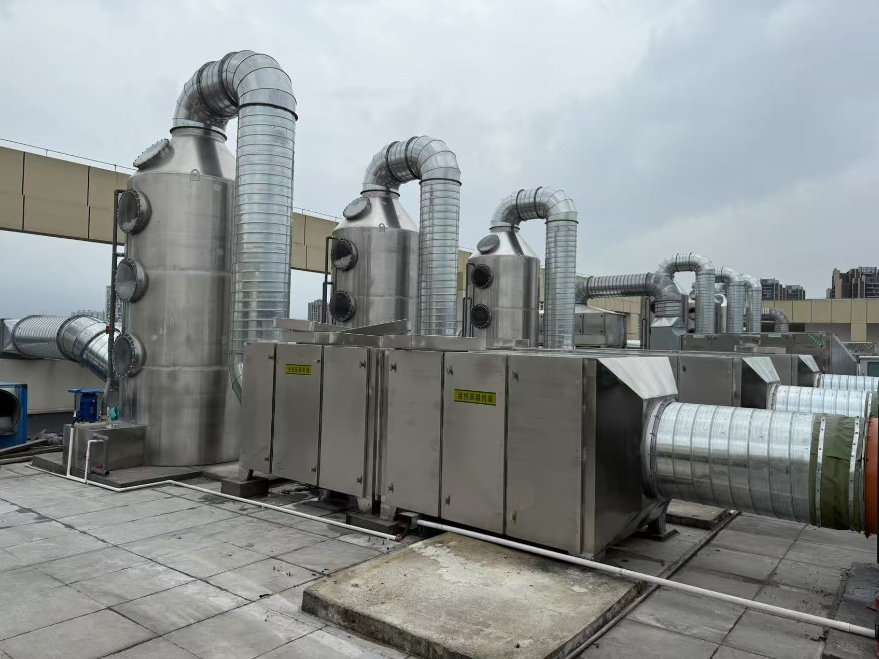
Precision Adaptation Principle: In view of the enterprise's waste gas characteristics of "multiple processes and multi-components", the combined process of "pretreatment + deep adsorption" is adopted. Water spray focuses on the removal of dust and soluble components, and two-stage activated carbon adsorption strengthens the purification of organic waste gas to realize precise treatment of different pollutants.
Safety and Stability Principle: Considering the flammable and explosive characteristics of organic waste gas, the equipment is equipped with safety devices such as waste gas concentration monitoring, explosion-proof ventilation and automatic alarm. The system adopts automatic operation control to adapt to the enterprise's multi-shift production rhythm and ensure continuous and stable operation.
Economic and High-efficiency Principle: Optimize process parameters and equipment layout to reduce system energy consumption and floor space. Adopt activated carbon filter material with high adsorption capacity and long service life, combined with regeneration technology to control operation and maintenance costs while ensuring treatment effect, realizing a win-win situation of environmental protection and economic benefits.
4. Design Objectives
The purification efficiency of organic waste gas is ≥95%. After treatment, the VOCs emission concentration ≤10mg/m³ and benzene series emission concentration ≤0.5mg/m³, which are better than GB 16297-1996 standard and local emission requirements, and conform to the trend of the latest upcoming ecological environmental standards.
The waste gas treatment system is equipped with a special exhaust funnel with a height of no less than 15 meters to ensure sufficient high-altitude diffusion of purified waste gas and avoid impacts on the surrounding environment and residents' lives.
The concentration of organic waste gas at each operating point in the workshop is controlled within the limit of GBZ 2.1-2019 standard, among which benzene ≤0.5mg/m³ and formaldehyde ≤0.5mg/m³. The pungent odor is completely eliminated to improve the operating environment and protect employees' occupational health.
The system realizes automatic operation and intelligent monitoring with functions such as waste gas concentration over-limit alarm and equipment fault early warning. It is convenient for operation and maintenance, meets the waste gas treatment demands under the enterprise's diversified production scenarios, and the annual stable operation time is ≥8000 hours.
5. Organic Waste Gas Treatment Process Design and Description
5.1 Process Selection Basis
Targeted graded treatment: Water spray can efficiently remove dust, paint mist and soluble acidic gas mixed in waste gas, preventing blockage or poisoning of the subsequent activated carbon adsorption layer and extending the service life of filter materials. Two-stage activated carbon adsorption strengthens the interception of insoluble organic pollutants such as benzene series and formaldehyde to ensure thorough purification effect.
Mature and stable technology: Both processes are mainstream technologies for industrial waste gas treatment with reliable equipment operation and simple operation. They adapt to the waste gas emission fluctuation of different production processes and can realize continuous or intermittent operation.
High economic applicability: The investment cost of process equipment is controllable. The water spray system has low energy consumption. Activated carbon can be recycled and regenerated to reduce consumable costs, meeting the economic benefit requirements of enterprises.
Outstanding environmental performance: No secondary pollution occurs during the treatment process. Saturated activated carbon is recycled and disposed of by professional institutions to realize standardized management of hazardous waste, conforming to the enterprise's green development concept.
5.2 Process Flow Chart
5.3 Detailed Process Description
Zoned precise gas capture: Customize gas collection systems according to the waste gas characteristics of different production areas of the enterprise. Enclosed gas collecting hoods are adopted for coating and plastic processing stations to form local negative pressure areas and reduce waste gas diffusion. Universal flexible suction arms are installed at electronic assembly stations to flexibly adapt to the operation of workpieces of various specifications. Mobile gas collection devices are equipped for temporary operation points of decoration projects. The hood mouth wind speed of each gas collecting hood is designed to be 1.2-1.8m/s to ensure the waste gas capture efficiency ≥90%.
Safe transportation and pretreatment: Adopt flame-retardant and anti-corrosion ventilation pipelines, divide transportation branches according to production areas, install guide plates at pipeline corners to reduce resistance, and set maintenance openings and pressure monitoring points every 8 meters. Dust-containing organic waste gas firstly enters the water spray purification tower. The spray liquid (added with weakly alkaline chemicals to adjust pH value) forms dense water mist through atomizing nozzles and fully contacts with waste gas. More than 90% of dust, paint mist and soluble acidic gas are removed through inertial collision, dissolution and absorption. The pretreated waste gas enters the gas-liquid separator to remove entrained water mist and avoid affecting the activated carbon adsorption effect.
Core adsorption and purification: The dehydrated waste gas successively enters the primary and secondary activated carbon adsorption towers. The primary adsorption tower is filled with granular activated carbon to mainly intercept high-concentration benzene series and alcohols in waste gas. The secondary adsorption tower adopts honeycomb activated carbon to strengthen the adsorption of small molecular organic compounds such as formaldehyde and acetone, ensuring thorough purification through double adsorption. The empty tower flow velocity of the activated carbon adsorption tower is designed to be 0.8m/s with an adsorption residence time ≥2s. When the resistance of the primary adsorption tower reaches 1800Pa, the system automatically switches to the standby adsorption tower to ensure continuous operation.
Regeneration and disposal of activated carbon: Saturated activated carbon is transferred to the activated carbon regeneration equipment through a special closed device and regenerated by thermal desorption method with a regeneration efficiency ≥85%. Waste activated carbon that cannot be regenerated is recycled and treated by qualified hazardous waste disposal institutions, with complete transfer and disposal accounts established to ensure environmental compliance.
Tail gas emission and monitoring: The purified waste gas is lifted to a 15-meter-high special exhaust funnel for discharge by a centrifugal induced draft fan. VOCs online monitoring equipment is installed at the top of the exhaust funnel to real-timely monitor parameters such as waste gas emission concentration and flow velocity, and connect to the local environmental protection department monitoring platform for dual supervision. The water quality of the circulating water tank is tested regularly, and the wastewater is reused after treatment or discharged into the enterprise sewage treatment system after reaching the standard.