
 +86 15853145085
Photocatalytic oxidation reacts under visible light irradiation. With semiconductor material and air as catalysts and light as energy source, this technology degrades organic pollutants into carbon dioxide and water. The company adopts high-efficiency nano photocatalyst loaded on honeycomb ceramics to achieve stable and optimal purification performance.
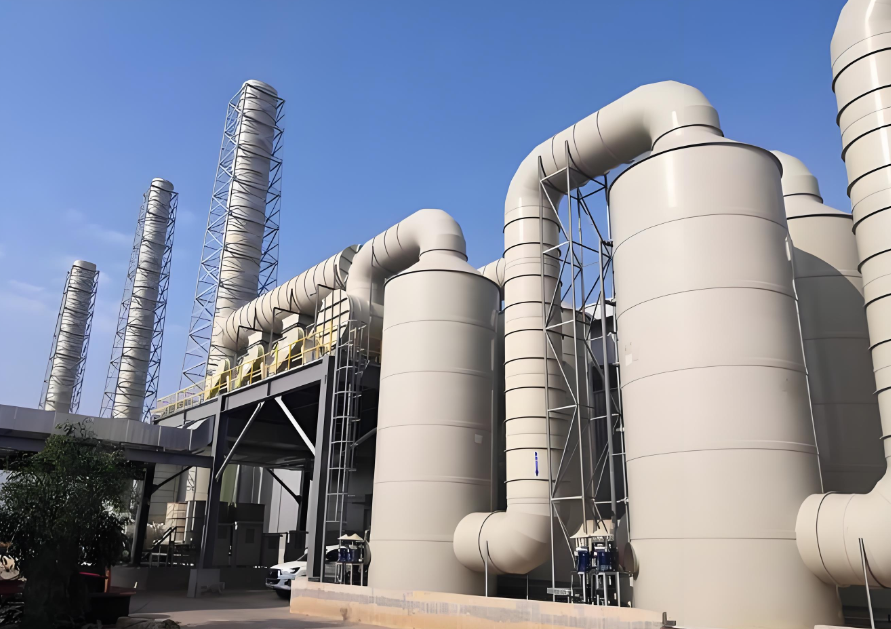
In the photocatalytic oxidation reaction, ultraviolet light irradiates the photocatalyst to generate electron-hole pairs. These pairs react with adsorbed water (H₂O) and oxygen (O₂) on the material surface to form strongly oxidative hydroxyl radicals (OH·) and superoxide radicals (O₂⁻). Various malodorous gases such as aldehydes, benzene series, ammonia gas, nitrogen oxides, sulfides and other VOC organic and inorganic pollutants can be completely decomposed into non-toxic carbon dioxide (CO₂), water (H₂O) and harmless inorganic substances. This equipment also has deodorization, disinfection and sterilization functions. No chemical additives are required during operation, resulting in zero secondary pollution.
The core nano photocatalytic material (GC-100) can trigger catalytic reactions after absorbing light energy. When irradiated by ultraviolet light with specific nano wavelength, redox reactions occur on the material surface. After photon absorption, the photocatalyst generates electrons (e⁻) and holes (h⁺), converting light energy into chemical energy to maintain continuous photocatalytic performance.
When contacting with moisture in the air, the surface of GC-100 adsorbs H₂O, O₂ and OH⁻. Water molecules and hydroxyl ions are oxidized by holes, while oxygen molecules are reduced by electrons. The chemical reaction process is shown as follows:
H₂O + h⁺ → OH· + H⁺ O₂ + e⁻ → O₂⁻
With strong oxidation capacity, hydroxyl radicals oxidize organic pollutants and finally decompose all contaminants into water and carbon dioxide.