
 +86 15853145085
Comprehensive Treatment Technology of Tar Waste Gas
Tar waste gas has complex components and contains toxic and harmful substances such as polycyclic aromatic hydrocarbons. The treatment adopts a combined process of pretreatment + core treatment + terminal control. Different schemes are applicable to waste gas with various concentrations and working conditions. The mainstream tar waste gas treatment processes and applicable scenarios are listed as follows:
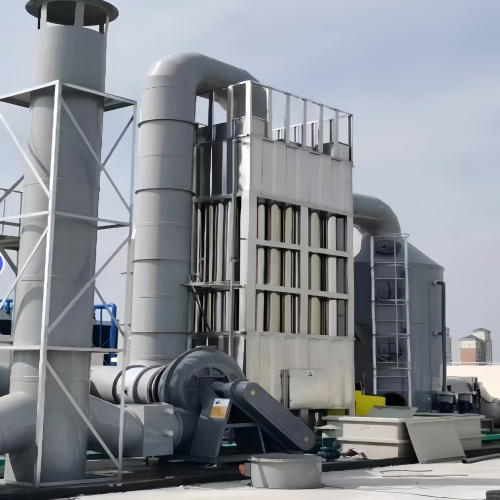
Ⅰ. Pretreatment Process (Removal of Large Tar Droplets)
The purpose of pretreatment is to reduce tar concentration and remove particulate matters in waste gas. It protects subsequent core treatment equipment and avoids blockage and equipment failure.
1. Electric Tar Precipitator
Principle: High-voltage electric field charges tar droplets. The charged droplets are adsorbed by electrodes, condensed into liquid and flow into the collecting tank.
Advantages: High tar removal efficiency (over 95%), low system resistance and large processing capacity. It is suitable for high-concentration tar mist waste gas such as exhaust gas from coking plants and coal gasification workshops.
Disadvantages: High equipment investment cost. The electrodes require regular cleaning with high operation and maintenance requirements.
2. Spray Absorption Tower
Principle: Organic solvents such as diesel oil and washing oil, or clean water are used as absorbents. The absorbent is in full contact with waste gas to dissolve and capture tar droplets.
Advantages: Simple structure, low investment cost and convenient operation. It can simultaneously remove partial acidic gases such as hydrogen sulfide (H₂S).
Disadvantages: The absorbent needs regular replacement or regeneration, easily generating secondary wastewater and waste liquid. The treatment efficiency is medium (70%~90%).
3. Bag Dust Collector (Membrane Filter Bag)
Principle: Polytetrafluoroethylene (PTFE) membrane filter bags are adopted to capture tar droplets and particles through screening and interception effects.
Advantages: Excellent removal effect on fine tar particles. Tar can be recycled. It is suitable for medium and low-concentration tar waste gas with high dust content.
Disadvantages: Filter bags are easy to be blocked by tar and require regular ash cleaning. The operating resistance increases gradually. It is not applicable to waste gas with high humidity and high-viscosity tar.
Ⅱ. Core Treatment Process (Degradation or Recovery of Tar Organic Matters)
The pretreated waste gas requires further degradation of organic components to meet emission standards.
1. Catalytic Oxidation (CO)
Principle: With the action of catalysts (precious metals such as Pt and Pd, or non-precious metals such as MnO₂ and CuO), tar organic matters are oxidized and decomposed into CO₂ and H₂O at a low temperature of 200~400℃.
Advantages: High treatment efficiency (≥95%), low energy consumption and no secondary pollution. Suitable for medium and high-concentration (500~5000mg/m³) tar waste gas.
Disadvantages: Catalysts are vulnerable to poisoning caused by tar, sulfur and phosphorus, requiring strict pretreatment. The equipment investment cost is relatively high.
2. Regenerative Thermal Oxidation (RTO/RCO)
Principle:
RTO: Waste gas is heated above 760℃ to decompose organic matters through direct combustion. Heat accumulators recover waste heat to reduce energy consumption.
RCO: Combining catalytic combustion and heat regeneration technology, combustion reaction occurs at 300~400℃ with lower energy consumption than RTO.
Advantages: High treatment efficiency (≥98%) and high heat recovery rate (≥90%). Suitable for large-air-volume and medium-high-concentration tar waste gas with complex components.
Disadvantages: Large equipment volume and high investment cost. RTO operates at high temperature with potential safety risks. The oxygen content and combustible concentration must be strictly controlled.
3. Adsorption and Recovery Method
Principle: Adsorbents such as activated carbon, activated carbon fiber and molecular sieve are used to adsorb tar organics. After saturation, tar is recycled through steam desorption and solvent elution.
Advantages: Valuable tar resources can be recycled without secondary pollution. Suitable for low-concentration (<500mg/m³) tar waste gas with high recycling value.
Disadvantages: Adsorbents need regular regeneration and replacement, resulting in high operating costs. Limited adsorption capacity makes it unsuitable for large-air-volume and high-concentration waste gas.
4. Biodegradation Method
Principle: Microbial metabolism decomposes tar organic matters into CO₂, H₂O and microbial biomass. Common processes include biological filter and biological trickling filter.
Advantages: Low operating cost, no secondary pollution and simple operation. Suitable for low-concentration (<100mg/m³) and biodegradable tar waste gas.
Disadvantages: The treatment efficiency is greatly affected by temperature, humidity and pH value. It has poor removal effect on refractory polycyclic aromatic hydrocarbons and covers a large floor area.
Ⅲ. Recommended Combined Processes
A single process cannot meet the treatment requirements of complex working conditions. Combined schemes are widely applied in practical projects:
1. High-concentration Tar Waste Gas: Electric Tar Precipitator + RCO
Most tar droplets are removed by the electric tar precipitator at first, and then organic matters are degraded by RCO catalytic combustion, balancing treatment efficiency and energy consumption.
2. Medium-concentration Dust-containing Tar Waste Gas: Spray Tower + Bag Dust Collector + Catalytic Oxidation
Pretreatment removes dust and most tar pollutants, and catalytic oxidation is adopted for advanced purification.
3. Low-concentration High-value Tar Waste Gas: Bag Dust Removal + Activated Carbon Adsorption and Recovery
Realize tar resource recovery to reduce operating costs.
4. Low-concentration Low-value Tar Waste Gas: Biological Trickling Filter + Activated Carbon Adsorption
Low-cost treatment with terminal adsorption to ensure compliant discharge.
Ⅳ. Precautions
1. Tar waste gas is flammable. The treatment system shall be equipped with safety facilities such as flame arresters, explosion-proof valves and leakage detection devices.
2. For sulfur-containing and chlorine-containing tar waste gas, attention shall be paid to equipment corrosion and catalyst poisoning. Corrosion-resistant materials and anti-poisoning catalysts are required.
3. Pretreatment is the key to the stable operation of the core process. The pretreatment mode shall be selected according to actual waste gas working conditions.