
 +86 15853145085
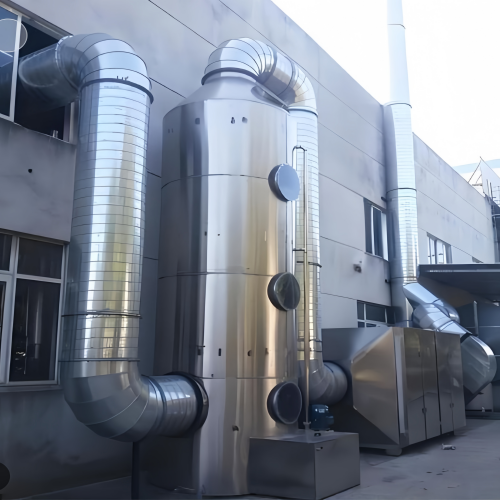
Spray tower, UV photocatalysis and plasma are common waste gas treatment technologies. They can be used independently or in combined application to achieve superior purification efficiency. The detailed introduction is as follows:
Ⅰ. Spray Tower
1. Working Principle
Based on gas-liquid two-phase mass transfer, waste gas flows upward from the tower bottom. The circulating pump transports washing liquid to the spraying device at the tower top for atomization and downward spraying. The gas and liquid are in full contact, and pollutants are removed through physical absorption, chemical reaction, inertial collision and interception.
2. Structural Composition
It is mainly composed of five parts: tower body, spraying system, mist removal device, circulation system and control system.
3. Technical Advantages
It has high purification efficiency for various pollutants; the simple structure facilitates installation and maintenance; it features strong adaptability for different types of waste gas and low operating cost with recyclable washing liquid.
4. Application Scenarios
Widely applied in chemical industry, metallurgy, power plant, coating and other industries for the treatment of acidic gas, alkaline gas and particulate matter.
Ⅱ. UV Photocatalysis Oxidation
1. Working Principle
When photons with energy higher than the semiconductor band gap irradiate the semiconductor material, valence band electrons transit to the conduction band to generate photogenerated holes and electrons. Photogenerated holes have strong oxidation capacity while electrons have reduction capacity. A series of photocatalytic reactions are triggered to produce strong oxidizing substances such as hydroxyl radicals, which oxidize and decompose organic pollutants into harmless carbon dioxide and water.
2. Technical Advantages
It can efficiently degrade and mineralize common gaseous organic pollutants without secondary pollution. UV light is adopted as energy source with relatively low operating cost.
3. Application Scenarios
Commonly used for removing gaseous pollutants such as VOCs in indoor air and automobile exhaust.
Ⅲ. Plasma Technology
1. Working Principle
Gas is ionized by high-voltage discharge to generate plasma containing a large number of active particles such as electrons, ions and free radicals. These active particles chemically react with waste gas pollutants to decompose contaminants into harmless substances. High-energy electrons can excite, ionize and crack pollutant molecules.
2. Technical Advantages
It has high treatment efficiency and can rapidly decompose various pollutants. The equipment covers a small area with simple operation.
3. Application Scenarios
Suitable for various industrial waste gas such as painting waste gas and printing waste gas, with excellent removal performance for VOCs.
Ⅳ. Combined Application of Processes
1. Spray Tower + UV Photocatalysis Oxidation
The spray tower conducts pretreatment to remove particulate matter, acidic gas, alkaline gas and partial water-soluble pollutants, reducing the initial pollutant concentration. Subsequently, the UV photocatalysis equipment further decomposes residual organic compounds for thorough purification. For example, a chemical enterprise adopts this combined process to treat waste gas containing benzene series and sulfides, achieving a removal rate of over 90% for non-methane hydrocarbons, benzene substances and sulfides.
2. Spray Tower + Plasma
The spray tower completes cooling, defogging and preliminary purification of waste gas to create stable operating conditions for subsequent plasma treatment. A large number of active particles generated by plasma equipment deeply decompose organic pollutants after pretreatment. This combined process has the advantages of high safety, high purification efficiency and simple operation, which is widely used in painting waste gas treatment.