
 +86 15853145085
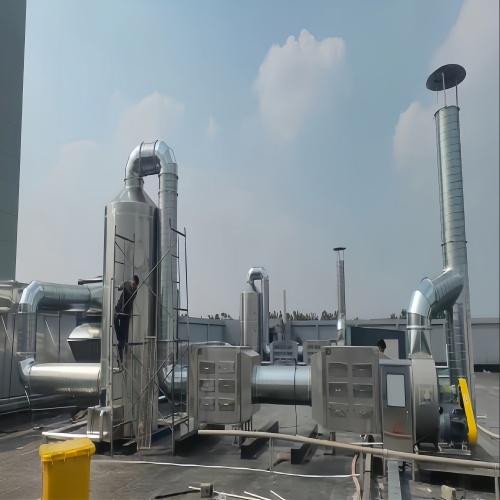
The spray tower is a typical gas-liquid contact purification equipment widely used in chemical waste gas treatment. Its core working principle is to achieve countercurrent or cocurrent contact between spray liquid and waste gas. Pollutants are removed through physical absorption, neutralization reaction and dissolution. According to different components and properties of chemical waste gas, targeted treatment schemes are adopted. The specific classification and applications are shown below:
Ⅰ. Core Treatment Schemes Classified by Spray Liquid Type
1. Alkaline Spray Scheme (For Acidic Waste Gas)
Applicable Waste Gas: Common acidic waste gas in chemical production, including HCl, H₂S, SO₂, partial NOₓ and fluorides. It is commonly exhausted from pesticide production, electroplating and acid pickling processes.
Spray Liquid Formula: Solutions such as NaOH (Sodium Hydroxide), Na₂CO₃ (Sodium Carbonate) and Ca(OH)₂ (Calcium Hydroxide). The liquid concentration is generally controlled at 2%–10%, which can be adjusted according to actual waste gas concentration.
Purification Principle: Acid-base neutralization reaction. The typical chemical equations are listed as follows:
HCl + NaOH = NaCl + H₂O
SO₂ + 2NaOH = Na₂SO₃ + H₂O
Process Characteristics: Simple equipment structure and low operating cost. It is required to regularly detect the pH value of spray liquid and replenish chemicals to prevent the decline of neutralization capacity.
2. Acidic Spray Scheme (For Alkaline Waste Gas)
Applicable Waste Gas: Alkaline waste gas such as ammonia (NH₃) and amines, which are discharged from chemical fertilizer production, pharmaceutical manufacturing and synthetic fiber processes.
Spray Liquid Formula: Dilute sulfuric acid (H₂SO₄) and dilute hydrochloric acid (HCl) with a concentration of 1%–5%.
Purification Principle: Acid-base neutralization reaction generates soluble salts. The typical chemical equation is listed as follows:
2NH₃ + H₂SO₄ = (NH₄)₂SO₄
Process Characteristics: It is necessary to avoid nozzle blockage caused by salt crystallization. An online cleaning device is recommended for auxiliary operation.
3. Water / Solvent Spray Scheme (For Water-soluble / Solvent-soluble Waste Gas)
Applicable Waste Gas: Water-soluble organic waste gas (methanol, ethanol, acetone), partial inorganic waste gas (ammonia), and special solvent-soluble waste gas (benzene series dissolved in diesel oil or engine oil).
Spray Liquid Formula: Clean water or special organic solvent. A small amount of surfactant can be added to improve gas-liquid contact efficiency during organic waste gas treatment.
Purification Principle: Realize gas-liquid mass transfer and separation by utilizing the solubility of pollutants in liquid medium.
Process Characteristics: No secondary pollution is produced. Solvent-containing spray liquid shall be recycled to avoid raw material waste.
4. Oxidative Spray Scheme (For Reductive and Odorous Waste Gas)
Applicable Waste Gas: Odorous waste gas such as H₂S, mercaptan and amines, as well as partial refractory organic waste gas from rubber processing, chemical production and landfill leachate treatment projects.
Spray Liquid Formula: Oxidant solutions such as NaClO (Sodium Hypochlorite), H₂O₂ (Hydrogen Peroxide) and KMnO₄ (Potassium Permanganate). A small amount of acid or alkali can be added to adjust pH value for strengthening oxidation performance.
Purification Principle: Strong oxidants decompose pollutants into harmless substances. For instance, H₂S is oxidized into SO₄²⁻ and Cl⁻ by NaClO.
Process Characteristics: High deodorization efficiency. Oxidants shall be dosed quantitatively to avoid chemical waste and secondary pollution caused by excessive addition.
Ⅱ. Combined Spray Tower Schemes (For Complex Chemical Waste Gas)
A single spray tower cannot handle chemical waste gas with complex components. Combined processes are widely adopted in practical engineering. The common combinations are as follows:
1. Multi-stage Series-connected Spray Towers
Typical combination: Acidic spray tower + Alkaline spray tower + Water washing tower. It is suitable for mixed waste gas containing acidic, alkaline and water-soluble pollutants, which can remove different contaminants step by step.
2. Spray Tower + Activated Carbon Adsorption
The spray tower firstly removes particulate matter, acidic and alkaline substances. The activated carbon adsorption tower further treats residual organic waste gas to improve terminal purification effect. This combination is applicable for coating waste gas and chemical synthetic waste gas.
3. Spray Tower + UV Photocatalysis / Plasma Oxidation
The spray tower removes macromolecular and water-soluble pollutants in the pretreatment stage. The subsequent photocatalysis or plasma equipment decomposes refractory small-molecule organic compounds. It is suitable for high-concentration and complex chemical organic waste gas.
4. Spray Tower + Biological Treatment
Pollutants are dissolved into the liquid phase by the spray tower, and then flow into biological filters or biotrickling filters for microbial degradation. This scheme is applicable for low-concentration and biodegradable organic waste gas such as alcohols and esters.
Ⅲ. Key Design Points of Spray Tower Process
1. Gas-liquid Contact Mode
Countercurrent spraying is given priority. Waste gas enters from the tower bottom, while spray liquid is sprinkled downward from the tower top. Longer gas-liquid contact time ensures higher purification efficiency.
2. Nozzle Selection
Spiral nozzles and hollow cone nozzles with excellent atomization effect are selected to prevent blockage and ensure uniform liquid coverage of the tower cross section.
3. Filler Selection
Polypropylene pall rings and cascade rings are installed to expand gas-liquid contact area and improve mass transfer efficiency. Acid and alkali resistant fillers are required for corrosive waste gas.
4. Tail Water Treatment
Spray wastewater shall be collected and treated through neutralization, coagulation sedimentation and oxidation. Qualified wastewater can be discharged or recycled to avoid secondary pollution.
Ⅳ. Application Scope and Limitations
Application Scope: It is applicable for the pretreatment of medium and low-concentration acidic, alkaline, water-soluble and odorous chemical waste gas, as well as dust-containing waste gas.
Limitations: Low purification efficiency for water-insoluble and refractory high-concentration organic waste gas (such as benzene, toluene and xylene). Auxiliary treatment equipment is required for combined purification.