
 +86 15853145085
Ⅰ. Scheme Background and Application Scope
1. Industry Status
Waste gas containing volatile organic compounds (VOCs), odorous gas and a small amount of toxic and harmful components is generated during pharmaceutical production, such as synthetic reaction, fermentation, extraction and drying. It is characterized by complex composition, large concentration fluctuation and obvious peculiar smell. Direct discharge will pollute the atmospheric environment and threaten human health. Therefore, efficient treatment is required to achieve compliant emission.
2. Applicable Scenarios
This scheme is suitable for the treatment of medium and low-concentration VOCs (concentration ≤1000mg/m³) and odorous gases (such as ammonia, hydrogen sulfide and organic amines) in pharmaceutical enterprises. It is especially applicable to intermittent production scenarios with single gas component or no recovery value. The system can operate independently as a terminal treatment unit or be combined with pretreatment processes such as condensation and spray washing.
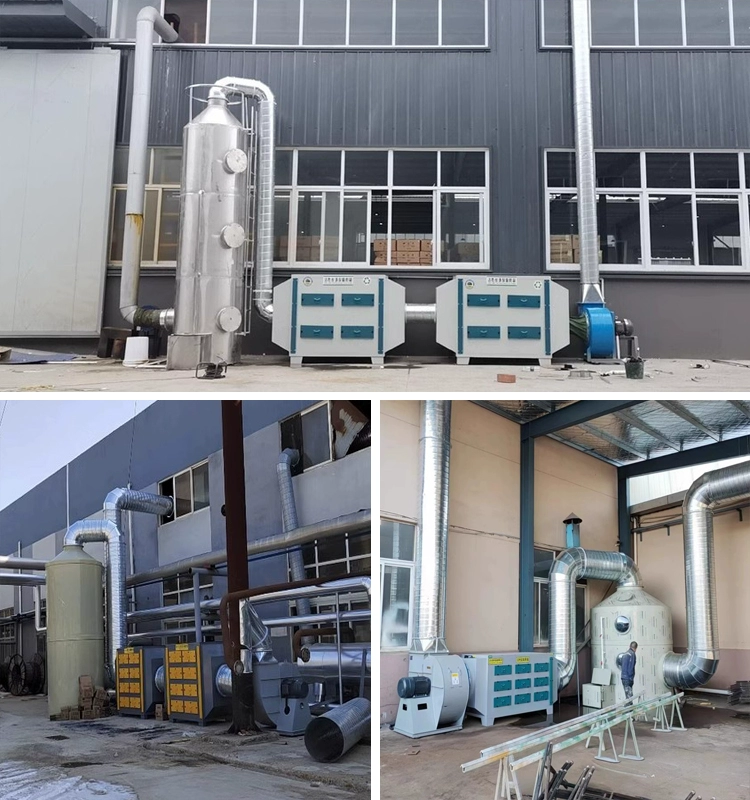
Ⅱ. Treatment Principle and Core Advantages
1. Adsorption Principle
Activated carbon has a developed pore structure with a specific surface area of 500-1500m²/g and strong adsorption capacity. When pharmaceutical waste gas passes through the activated carbon adsorption bed, pollutant molecules are physically or chemically adsorbed (functional modified carbon) in carbon pores to realize gas purification, and the purified gas is discharged up to standard.
2. Core Advantages
Mature Technology: Simple process, convenient operation and high operational stability without complex reaction conditions.
Controllable Cost: Low equipment investment and low daily energy consumption, which is suitable for small and medium-sized pharmaceutical enterprises.
High Purification Efficiency: The adsorption efficiency for most VOCs and odorous gases can reach more than 90%, realizing effective deodorization.
Strong Adaptability: It can treat various gas components and tolerate concentration fluctuation without targeted process adjustment.
Ⅲ. Process System Design
1. Technological Process
Waste Gas Collection → Pretreatment → Fan Conveying → Activated Carbon Adsorption Bed → Standard Discharge
(1) Waste Gas Collection
Closed hoods and pipeline systems are adopted to collect waste gas from each production node. The collection efficiency is ≥95% to reduce unorganized emission.
(2) Pretreatment System
A spray washing tower (filled with lye or clean water) is equipped to remove dust, acidic/alkaline components and partial water-soluble pollutants, preventing carbon blockage and corrosion and extending the service life of adsorbent.
(3) Fan Conveying
Anti-corrosion and explosion-proof centrifugal fans are selected. The air pressure and air volume are matched according to waste gas flow to ensure stable gas flow through the adsorption bed.
(4) Activated Carbon Adsorption Bed
As the core treatment unit, it adopts a fixed-bed structure. The gas flows downward or horizontally through the carbon layer for sufficient adsorption contact.
2. Key Parameter Design
Treatment Air Volume: Calculated according to production scale with 10%-20% margin to avoid overload operation.
Empty Bed Velocity: Controlled at 0.3-0.8m/s to ensure sufficient adsorption time (≥10s).
Carbon Filling Quantity: Calculated according to air volume, adsorption capacity and operation cycle. The filling height is generally 0.8-1.5m.
Carbon Selection: Honeycomb or columnar activated carbon is preferred (large specific surface area, high adsorption capacity and low airflow resistance). Modified activated carbon is adopted for special waste gas containing chlorine and sulfur.
Operating Temperature: Controlled at 5-40℃. Excessively high temperature will reduce adsorption capacity; high-temperature waste gas shall be prohibited from directly entering the adsorption bed.
Ⅳ. Equipment Selection and Configuration
Equipment Name | Selection Requirements | Core Function |
Exhaust Gas Pipeline | PP or FRP anti-corrosion material; pipeline wind speed: 10-15m/s | Efficient gas collection and leakage reduction |
Spray Washing Tower | Countercurrent tower; PP/FRP material; equipped with atomizing nozzles and demisting layer | Remove dust and acid-base components for gas pretreatment |
Centrifugal Fan | Anti-corrosion & explosion-proof; air volume matched with processing scale; wind pressure ≥1500Pa | Provide power for stable gas transportation |
Activated Carbon Adsorption Bed | Q235B material with internal and external anti-corrosion treatment; single-bed or double-bed design | Core adsorption unit for pollutant removal |
Activated Carbon | Honeycomb carbon (specific surface area ≥1000m²/g) or columnar carbon | Adsorb VOCs and odorous components |
Control System | Equipped with air flow, temperature and pressure difference monitoring with fan linkage control | Real-time monitoring to ensure safe and stable operation |
Ⅴ. Operation and Maintenance Management
1. Daily Operation Procedures
Startup Sequence: Start the spray tower firstly → activate the fan → feed waste gas. Ensure the normal operation of pretreatment before gas entering the adsorption bed.
Operation Monitoring: Regularly check fan operating condition, pressure difference between inlet and outlet of adsorption bed (normal range: 0.5-1.5kPa; excessive pressure difference indicates carbon blockage), and exhaust effect through odor and monitoring data.
Shutdown Sequence: Stop gas feeding → keep fan and spray tower running for 10-15 minutes → shut down the fan → close the spray tower.
2. Carbon Replacement and Regeneration
Replacement Cycle: Determined by gas concentration, air volume and adsorption efficiency, generally 3-6 months. Replace carbon timely when outlet concentration approaches emission standard or peculiar smell increases.
Replacement Method: Manual replacement. Double-bed design realizes one bed for operation and one for standby to guarantee continuous production.
Waste Carbon Disposal: Waste activated carbon is classified as hazardous waste. It shall be disposed or regenerated by qualified institutions; arbitrary disposal is strictly prohibited.
3. Maintenance Points
Daily Inspection: Check fan noise and vibration, spray tower liquid level and atomization effect, and air tightness of adsorption bed.
Weekly Inspection: Clean sediment inside the spray tower, inspect pipeline tightness and calibrate monitoring instruments.
Monthly Inspection: Check anti-corrosion layer of adsorption bed and fan lubricating oil; replace circulating water of spray tower.
Regular Monitoring: Entrust third-party testing institutions to detect inlet and outlet gas concentration quarterly to ensure compliant discharge.
Ⅵ. Safety and Environmental Protection Requirements
1. Safety Protection Measures
Explosion-proof Design: Anti-static grounding is implemented for adsorption beds, fans and pipelines (grounding resistance ≤10Ω). Explosion-proof lamps and ventilation facilities are equipped to avoid VOCs accumulation and explosion risk.
Fire Prevention Measures: Dry powder or carbon dioxide fire extinguishers are arranged around adsorption beds; open flame is strictly prohibited.
Personnel Protection: Operators shall wear gas masks and protective gloves to avoid direct contact with waste gas and waste carbon.
2. Environmental Compliance Requirements
Emission Indicators: The treated VOCs concentration shall comply with Emission Standard of Air Pollutants for Pharmaceutical Industry (GB 37823-2019), and odor concentration shall meet Emission Standards for Odor Pollutants (GB 14554-93).
Unorganized Emission Control: All connecting parts and flange joints shall be well sealed without obvious odor leakage.
Hazardous Waste Management: Establish collection, storage and transfer ledgers for waste carbon, and strictly implement hazardous waste transfer manifest system.
Ⅶ. Economic Analysis of the Scheme
1. Investment Cost (Single Set, Air Volume: 10000m³/h)
Equipment Investment: Approximately 300,000-500,000 RMB (including pipelines, spray tower, fan, adsorption bed and control system).
Carbon Cost: About 50,000-80,000 RMB/year (replacement cycle: 4 months).
Operating Cost: Electricity cost: 80,000-120,000 RMB/year (fan power: 15-22kW, annual operation: 8000h); water and chemical cost: 10,000-20,000 RMB/year.
Maintenance Cost: Approximately 20,000-30,000 RMB/year (including equipment maintenance and instrument calibration).
2. Cost Advantages
Compared with catalytic combustion and adsorption-desorption processes, the activated carbon adsorption scheme reduces equipment investment by 30%-50% and operating cost by 20%-40%. It is suitable for pharmaceutical waste gas with medium-low concentration and small air volume. Without complex heating or desorption system, it features low operation and maintenance difficulty.