
 +86 15853145085
Ⅰ. Source of Pharmaceutical Waste Gas
Pharmaceutical enterprises adopt various organic solvents with low melting points and high volatility during the production process. These solvents are highly volatile and easily cause air pollution. Waste gas is mainly discharged from operating units such as feeding, chemical reaction, solvent recovery, filtration, centrifugation, drying and discharging.
Ⅱ. Hazards of Pharmaceutical Waste Gas
A large number of organic solvents are widely used in the pharmaceutical and chemical industry, including DMF, benzene series, organic amines, ethyl acetate, dichloromethane, acetone, methanol, ethanol, butanone, ether, dichloroethane, acetic acid and chloroform. Volatilized solvents generate pungent and odorous toxic gas. Long-term emission will inevitably deteriorate regional air quality and harm the physical health of nearby residents. Therefore, effective VOCs pollution control for the pharmaceutical industry has become an urgent problem to be solved.
Ⅲ. Components of Pharmaceutical Waste Gas
DMF, benzene series, organic amines, ethyl acetate, dichloromethane, acetone, methanol, ethanol, butanone, ether, dichloroethane, acetic acid, chloroform and other substances.
Ⅳ. Characteristics of Pharmaceutical Waste Gas
(1) Numerous discharge points, large emission capacity and serious unorganized emission. The yield of pharmaceutical and chemical products is low with large solvent consumption. Solvent waste gas has multiple discharge points and is mostly discharged at low altitude in an unorganized manner with relatively high concentration.
(2) Frequent intermittent emission. Most chemical reactions are intermittent, resulting in intermittent discharge of solvent waste gas.
(3) Unstable emission state. The composition of solvent waste gas is complex with variable types and concentrations of pollutants. The same production unit may discharge different pollutants in different periods.
(4) Wide influence range. Most VOCs in solvent waste gas have peculiar smell, low odor threshold and strong diffusivity, causing widespread environmental impact.
(5) High production risk. A large quantity of flammable and explosive substances are used in the production process with intense chemical reactions, leading to high risk of production accidents.
Ⅴ. Pharmaceutical Waste Gas Treatment Solutions
(1) Activated Carbon Adsorption Solution
After entering the adsorption box, pharmaceutical waste gas passes through the activated carbon adsorption layer. Unbalanced molecular attraction and chemical bonding force exist on the activated carbon surface. When the adsorbent contacts with waste gas, gas molecules are attracted and gathered on the solid surface, which is defined as adsorption. Relying on the adsorption capacity of porous activated carbon with large specific surface area, pollutants in waste gas are trapped and separated from the gas mixture. The purified gas is discharged at high altitude.
1. Technical Characteristics
(1) High adsorption efficiency and strong adsorption capacity.
(2) Capable of treating multiple mixed organic waste gases simultaneously with high purification efficiency.
(3) Small floor area, simple maintenance and low operating cost.
(4) Strong adaptability. The fully sealed structure is applicable both indoors and outdoors with a wide application range.
(5) Adopting automatic control design for simple and safe operation.
2. Application Scope
Activated carbon adsorption technology is widely used for low-concentration and high-air-volume waste gas treatment in industries such as petroleum, chemical industry, rubber, coating, printing, electronics, pharmaceutical, textile printing and dyeing, food, furniture, plastic, feed, leather, machinery, semiconductor manufacturing and material synthesis.
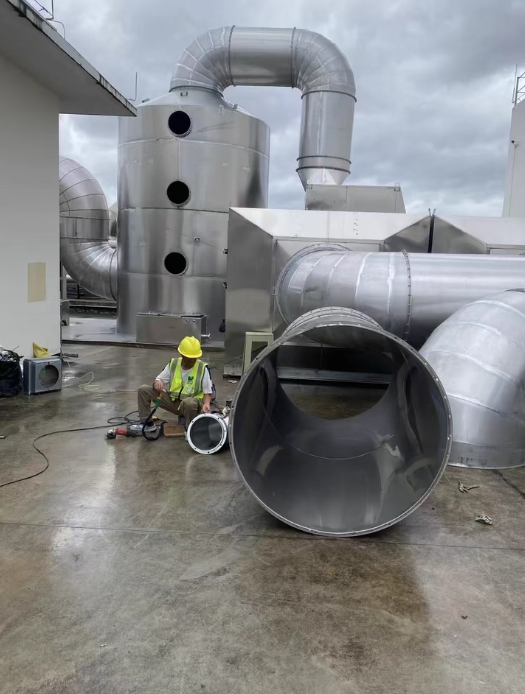
(2) UV Photolysis Purification Solution
UV photolysis waste gas treatment technology adopts high-energy UV ultraviolet beams to decompose oxygen molecules in the air and generate free active oxygen. Due to unbalanced positive and negative electrons, free oxygen combines with oxygen molecules to produce ozone. With strong oxidizing property, ozone synergistically decomposes and oxidizes organic waste gas and odor gas, degrading pollutants into low-molecular compounds, water and carbon dioxide.
1. Technical Characteristics
(1) Efficient deodorization: It can effectively remove VOCs, inorganic substances, hydrogen sulfide, ammonia, mercaptans and other odorous pollutants. The deodorization efficiency exceeds 95%, complying with Emission Standards for Odor Pollutants (GB14554-93) and Integrated Emission Standard of Air Pollutants (GB16297-1996).
No pretreatment is required. The equipment can operate normally under the ambient temperature of -30℃ to 95℃, humidity of 30% to 98%, and PH value of 2 to 11 without heating or humidifying treatment.
(2) No additional chemicals required: Only exhaust pipelines and exhaust power are needed for waste gas conveying. No extra substances participate in chemical reactions during purification.
(3) Strong adaptability: Suitable for purification of medium and low-concentration industrial waste gas. Continuous 24-hour stable operation is available.
(4) Low operating cost: No mechanical movement and noise. Regular inspection is required without manual supervision. The equipment features low energy consumption and low wind resistance (less than 50pa), saving exhaust power consumption.
(5) High safety and reliability: Adopting photolysis principle with explosion-proof modules. The equipment has excellent fireproof, explosion-proof and anti-corrosion performance. It is especially suitable for industries with high explosion-proof requirements such as oilfields, petrochemical industry and pharmaceutical industry.
2. Application Scope
It is applicable to the purification of odorous gas and industrial waste gas in printing factories, printing and dyeing mills, electronic factories, plastic factories, coating factories, furniture factories, oil refineries, rubber factories, chemical plants, paper mills, leather factories, pesticide factories, pharmaceutical factories, paint factories, chemical fertilizer plants, food processing plants, feed factories, spice factories, slaughterhouses, sewage treatment plants, garbage transfer stations and spraying workshops.
(3) Catalytic Combustion Solution
Regenerative Thermal Oxidation (RTO) technology heats organic waste gas above 760℃ to oxidize and decompose VOCs into carbon dioxide and water. The high-temperature flue gas generated by oxidation flows through special ceramic regenerators for heat storage. The stored heat is used to preheat the subsequent organic waste gas, reducing fuel consumption for gas heating.
1. Technical Characteristics
(1) Self-heating combustion is realized for high-concentration waste gas with low operating cost and high cost performance.
(2) High purification efficiency; the purification rate of three-chamber RTO can reach 99.5%.
(3) Ceramic regenerators are adopted for heat recovery with alternating preheating and heat storage processes. The thermal efficiency is not less than 95%.
(4) The furnace adopts reliable steel structure and thick thermal insulation layer for safe and stable operation.
(5) PLC programmable automatic control system with high automation degree.
(6) Wide applicability for all kinds of organic waste gas.
(7) Waste heat recycling brings high economic benefits. Excess heat can be reused for drying rooms and ovens to save extra fuel and electric energy consumption.
2. Application Scope
It is suitable for the treatment of medium and high-concentration high-air-volume organic waste gas in industries such as petroleum, chemical industry, plastic, rubber, pharmaceutical, printing, furniture, textile printing and dyeing, coating, semiconductor manufacturing and synthetic materials. The treatable organic substances include benzene series, phenols, aldehydes, ketones, esters, alcohols and hydrocarbons.