
 +86 15853145085

 National Service Hotline
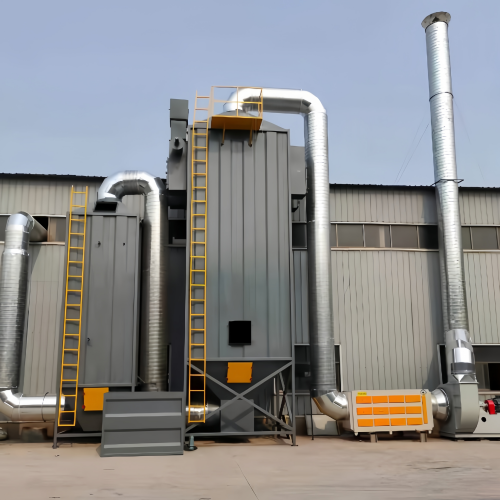
The core working principle of the high voltage electric tar precipitator is to realize gas-liquid and gas-solid separation through the ionization effect of a high-voltage electrostatic field, so as to capture pollutants such as tar droplets and fine dust in waste gas. It is specifically divided into four key steps:
1. High Voltage Ionization and Corona Zone Generation
High voltage ionization and corona zone generation: The equipment is internally equipped with cathode wires (charge-releasing electrodes, such as thorn wires) and anode plates or anode tubes (charge-collecting electrodes). When 20kV–60kV high-voltage direct current is applied to the cathode wires, the electric field intensity around the cathode rises sharply to form a corona zone. In the corona zone, air molecules are ionized into a large number of positive ions, negative ions and free electrons.
2. Particle Charging
Particle charging: When waste gas containing tar and dust passes through the electric field, flowing tar droplets and fine particles collide with ions and electrons in the corona zone to carry electric charges, which is defined as charging. The particle charge capacity is positively correlated with its particle size and electric field intensity; the larger the particle size, the faster the charging speed and the higher the charge quantity.
3. Directional Migration Driven by Electric Field
Electric field driven directional migration: Charged tar particles and dust move directionally toward electrodes with opposite polarities under electric field force. Negatively charged particles migrate to anode plates or tubes, while positively charged particles move toward cathode wires (negligible in proportion). The migration speed is determined by electric field intensity and particle charge quantity; stronger electric field and higher charge capacity bring faster migration speed.
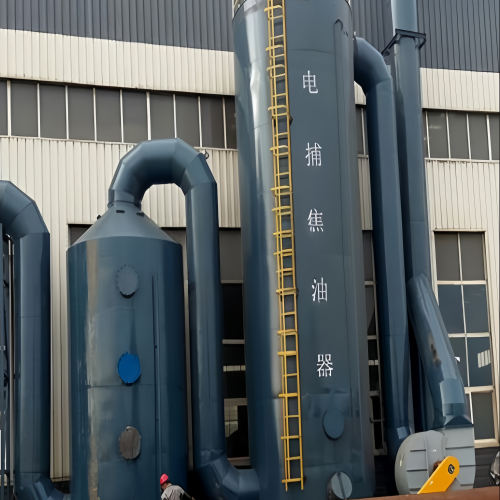
4. Sedimentation, Capture and Exhaust
Sedimentation, capture and exhaust: Charged particles finally deposit on the surface of anode plates or tubes and gradually condense into large tar oil films or dust layers. For dry-type electric tar precipitators, sediments are shaken off into the oil collecting or dust collecting tank at the bottom by periodic rapping devices. For wet-type electric tar precipitators, water film is formed by continuous spraying to flush pollutants downwards. The purified waste gas is discharged from the outlet to complete gas-pollutant separation.
5.Core Design Points
Thorn-shaped cathode wires are adopted to enhance local electric field strength, facilitate corona discharge and improve ionization efficiency.
Anode plates and tubes shall be kept flat and clean. Excess tar or dust sediment will weaken the electric field and reduce capture efficiency, so regular maintenance is essential.
For flammable and explosive waste gas (such as plastic granulation waste gas), the equipment shall adopt explosion-proof design, equipped with spark detection, automatic power-off and other safety devices to avoid explosion caused by corona discharge sparks.