
 +86 15853145085

 National Service Hotline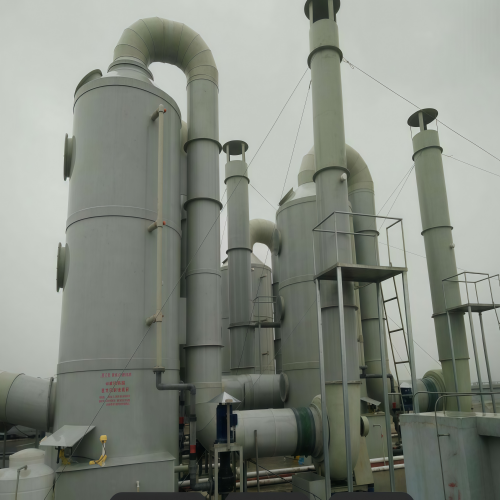
The biological scrubber spray tower is a commonly used environmental protection equipment for waste gas treatment, which is an application of the biological absorption method. The detailed introduction is as follows:
Structural Composition
Absorption Chamber
It is the main part of the biological scrubber spray tower. Waste gas enters from the bottom of the absorption tower, and biological suspension (circulating liquid) is sprayed downward from the top. The two substances fully contact here to realize the transfer of pollutants from gas phase to liquid phase.
Regeneration Tank
The biological suspension absorbing pollutants flows into the regeneration tank, where air is injected for oxygenation and regeneration. Microorganisms in the tank degrade pollutants. The effluent from the regeneration tank flows into the secondary sedimentation tank for mud-water separation, and part of the outflow liquid circulates back to the absorption tower.
Spray System
It is composed of main distribution pipes and nozzles, which is used to atomize the spray liquid and inject it into the waste gas to ensure sufficient contact between waste gas and spray liquid.
Defogging Device
Installed at the top of the tower to separate liquid droplets carried by waste gas and prevent liquid from discharging out of the tower.
Circulating Pump and Circulating Water Tank
The circulating pump transports the spray liquid in the water tank to the spray system to ensure continuous liquid supply.
Working Principle
The biological scrubber spray tower adopts a two-stage process of "absorption first and then degradation". Firstly, in the scrubber tower, waste gas fully contacts with absorption liquid containing activated sludge or specific microbial agents. Water-soluble pollutants are quickly transferred from gas phase to liquid phase. Then, the pollutant-rich absorption liquid is sent into the bioreactor (aeration tank). Under aerobic conditions, microorganisms completely degrade pollutants into substances such as carbon dioxide and water.
Types
Spray Type
Its structure is similar to the biological trickling filter tower. The difference is that microorganisms in the scrubber tower mainly exist in the liquid phase, while microorganisms in the trickling filter tower attach to the surface of filter media.
Bubbling Type
It is a three-phase fluidized bed. The typical structure consists of two interconnected reactors. One is the absorption unit, which makes gas contact with the mixed liquid of water, packing and biomass through bubbling to transfer pollutants from gas phase to liquid phase. The other is the biological degradation unit for pollutant biodegradation. Sometimes the two reactors are combined into one single equipment.
Characteristics
Advantages
It has high treatment efficiency and fast reaction speed. It is especially suitable for treating water-soluble pollutants with large air volume, such as alcohols and aldehydes. The equipment covers a relatively compact area. The pH value and humidity are easy to control for direct adjustment of the liquid environment, with no packing blockage problem.
Disadvantages
The system structure is complicated with high investment and operating costs. Liquid waste needs subsequent treatment, and waste liquid may be generated for further disposal.
Application Fields
It is mainly used to treat industrial waste gas containing volatile organic compounds (VOCs), ammonia, hydrogen sulfide and other pollutants, as well as odor gas generated during sewage treatment. It is widely applied in food processing, fermentation, pharmaceutical, chemical and other industries.
Core Advantages of Biological Scrubber Spray Tower
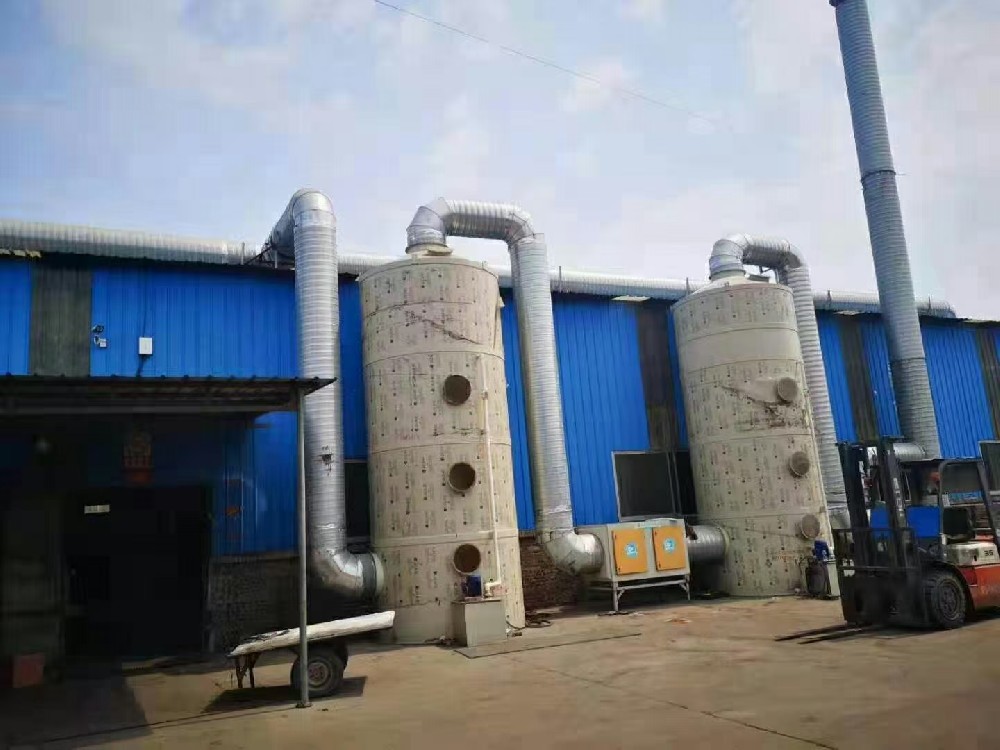
The core advantages of the biological scrubber spray tower are reflected in treatment efficiency, operational stability and application scope, which are specified as follows:
High Pollutant Removal Efficiency
Waste gas makes countercurrent contact with microbial-containing spray liquid to form a large gas-liquid contact area. Water-soluble pollutants (such as ammonia, hydrogen sulfide, low-molecular alcohols and aldehyde VOCs) can be quickly transferred from gas phase to liquid phase and degraded by microorganisms. The overall removal rate is generally 80%~95%, which is suitable for waste gas with high concentration and large air volume.
Strong Operational Stability Without Blockage Risk
Different from biological trickling filters relying on biofilm on packing surfaces, microorganisms of the biological scrubber spray tower are mainly suspended in the liquid phase. There is no packing blockage or compaction problem. It has strong adaptability to working conditions with a small amount of dust or viscous substances in waste gas, and low failure rate during long-term operation.
Flexible and Simple Operation Control
Parameters such as pH value, temperature and nutrient salt concentration in the liquid phase can be quickly controlled by chemical dosing and working condition adjustment, so as to accurately match the optimal growth conditions of microorganisms and avoid treatment efficiency decline caused by environmental fluctuation.
Less Secondary Pollution and Good Environmental Protection
Pollutants are eventually degraded into harmless substances such as carbon dioxide, water and inorganic salts by microorganisms without secondary waste residue or waste gas. Excess activated sludge can be disposed of as conventional sewage sludge, causing little impact on the environment.
Compact Floor Area
The two core links of absorption and degradation can be designed in an integrated structure. Compared with physical adsorption methods (such as activated carbon towers with frequent packing replacement and large occupation) or chemical oxidation methods (supporting chemical storage equipment), the equipment layout is more compact and saves plant land occupation