
 +86 15853145085

 National Service Hotline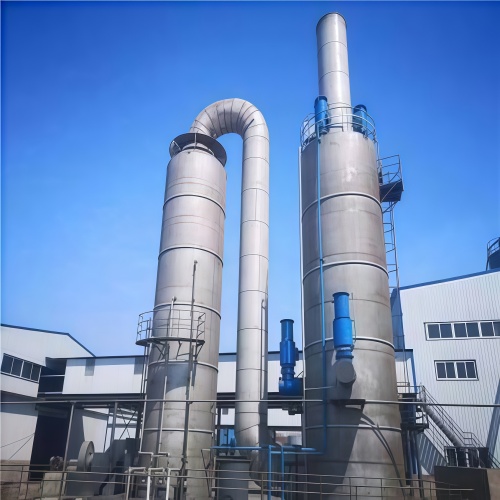
General introduction: The spray tower is a common equipment in chemical waste gas treatment. It has the characteristics of high efficiency, flexibility and economy.
Detailed introduction is as follows:
Working Principle
The spray tower adopts a triple purification mechanism of gas-liquid counter-current contact, physical adsorption and chemical reaction. Waste gas enters from the bottom and fully contacts with absorption liquid in the packing layer. Pollutants are transferred into the liquid phase through physical dissolution, inertial collision or chemical reaction. The purified gas passes through the demisting layer and reaches the emission standard.
Structural Composition
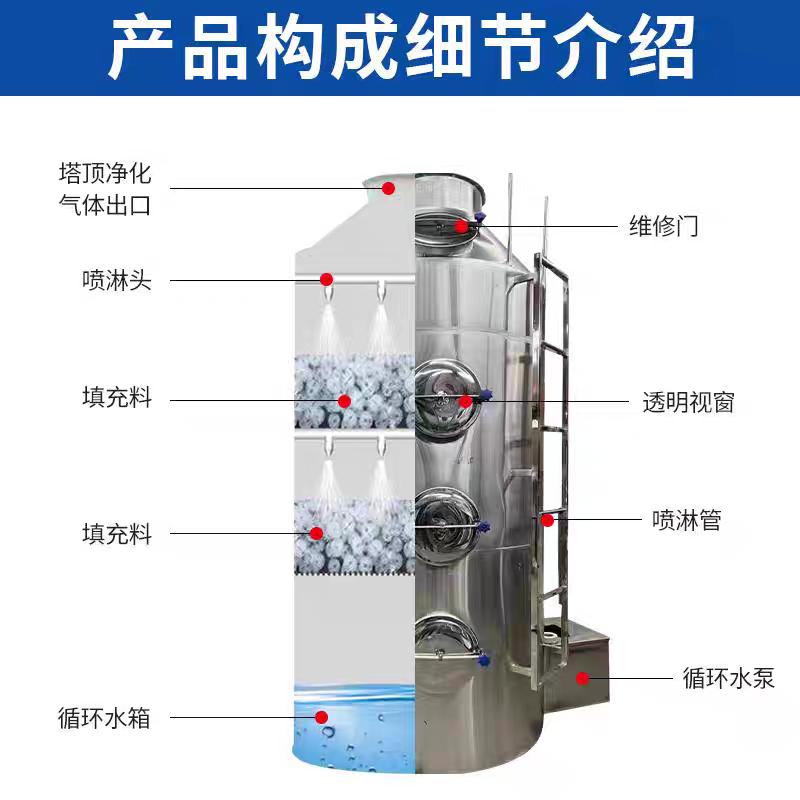
Tower body: Adopt cylindrical structure and corrosion-resistant materials such as FRP and stainless steel. The size is determined according to waste gas treatment capacity.
Spraying system: Consists of pipelines and nozzles. Spiral and centrifugal nozzles evenly distribute washing liquid to expand gas-liquid contact area.
Demisting device: Installed at the top. Baffle-type and wire mesh demisters remove entrained droplets to avoid secondary pollution and equipment corrosion.
Circulation system: Composed of circulating pumps, water tanks and pipelines. The washing liquid is transported for spraying, flows back after pollutant absorption, and is recycled after treatment.
Control system: Monitor and adjust gas flow, liquid flow and pH value to ensure stable equipment operation.
Types
According to structural design: Vertical type and horizontal type. Vertical towers realize counter-current gas-liquid contact, while horizontal towers adopt cross-flow contact mode.
Technical Advantages
High treatment efficiency: The removal rate of acidic gas, alkaline gas and particulate matter can exceed 90%.
Simple structure: Easy to install and maintain with low technical requirements for operators.
Strong adaptability: Washing liquid and absorbents can be selected according to different waste gas components.
Low operating cost: Recyclable washing liquid reduces energy consumption and maintenance expenses.
Application Scenarios
Spray towers treat VOCs, acidic gas, alkaline gas and dust particles in chemical production. Alkaline liquid removes acid gas such as SO₂ and HCl. Combined processes with activated carbon are applied for multi-component VOCs treatment in coating and pharmaceutical industries.
Practical Cases
A petrochemical enterprise adopts the combined process of spray tower and catalytic combustion. Alkaline liquid neutralizes acidic gas, and soluble organics are physically absorbed. The pollutant concentration is reduced by more than 60% after spraying. The remaining waste gas is deeply oxidized to meet emission standards.
Development Trend
With the development of Internet of Things, spray towers are becoming intelligent. Sensors monitor operating parameters to realize on-demand treatment. Carbon capture technology is combined to form a treatment and resource utilization closed loop.
Classification by Applicable Waste Gas
Acidic waste gas: The most mainstream application. Alkaline absorbents such as sodium hydroxide treat HCl, H₂S, SO₂, NOₓ and fluoride in chemical, metallurgical and electroplating industries.
Alkaline waste gas: Acidic absorbents such as dilute sulfuric acid remove ammonia and organic amine gas from pharmaceutical, chemical and food processing industries.
Water-soluble organic waste gas: Water or special additives treat low-boiling organics such as methanol, ethanol, acetone and formaldehyde from coating and printing industries.
Dust-containing waste gas: Remove non-viscous and non-fibrous dust such as cement dust and pigment powder, especially suitable for high-humidity dusty flue gas.
Oil mist waste gas: Separate oil mist and lampblack through water film and degreasing agents in mechanical processing and heat treatment industries.
Application Limitations
Spray towers have low removal efficiency for insoluble and high-boiling VOCs such as benzene, toluene and xylene. Such waste gas requires combined technologies such as activated carbon adsorption and catalytic combustion.Temperature Drop Analysis of Spray Tower
The temperature drop range is mainly affected by inlet temperature, liquid temperature and gas-liquid ratio. The conventional cooling range is 10-40℃, and the extreme value can exceed 50℃.
Core Influencing Factors
Inlet gas temperature: High-temperature flue gas (100-200℃) drops by 30-50℃; medium and low-temperature gas (40-80℃) drops by 10-20℃.
Spray liquid temperature: Lower liquid temperature brings better cooling effect. Low-temperature liquid can increase temperature drop by 5-10℃.
Gas-liquid ratio: Higher ratio enhances heat exchange. Doubled ratio increases cooling range by 10-15℃.
Spraying form: Counter-current spraying and fine atomization improve cooling efficiency by 5-10℃.
Gas humidity: Dry gas has larger temperature drop, while high-humidity gas reduces cooling range by 5-10℃.
Typical Working Condition Cases
Plastic granulation waste gas: Inlet 120-150℃, temperature drop 30-40℃.
Chemical acid-base waste gas: Inlet 60-80℃, temperature drop 15-25℃.
Boiler flue gas pretreatment: Inlet 180-200℃, temperature drop 50-60℃.
Precautions
Excessive cooling may cause condensation, corrosion and packing blockage. Temperature control devices and multi-stage spraying can be equipped for precise adjustment. Excessively low temperature of high-concentration VOCs shall be avoided to prevent condensation and potential safety hazards